Skip to content

2 bites of business…

1) Just a very quick word to let you know the process has finally begun. One by one I’m going through the recipes previously posted here and condensing them for print. (I do tend to get a bit wordy – ohhhh…you’ve noticed? I’m hurt! – so hopefully this will make the process of using them in your kitchen a bit friendlier.) I’ve set up a new blog site called sprees-recipe-box where they’ll all be housed. A link will be provided at the bottom of each post (once I have them linked.) It’ll take me a bit of time to get them all up, but by March I expect they’ll each be ready.

2) Also, there’s going to be a new feature here. Do have any idea how many times while whiling away the day in the kitchen I think of little things I’d love to share with you? (plenty!) Sometimes, just a little happy-ending tweak to a recipe already posted here; sometimes a neat little trick, or maybe an inexpensive little gadget, or new tricks with an old one; a bit of kitchen trivia that spree finds amusing. You get the picture: too small for their own post, too kind-of-cool not to mention. Little tidbits, pinches of spice, little sprinkles of something sweet. That’s it!

S p r e e n k l e s!

Then it’s settled.

They’ll begin today.

I’ll identify them in the post name so subscribers who don’t want to make the trip for crumbs (even sweet ones) won’t need to. You can catch it the next time you happen back. I’ll keep a running list of them in their own page in the header space above. And by all means, if there’s something YOU want to share with the rest of us, now might be a good time! I’ll be happy to post it (and give full credit of course!) Now, I need to say one more thing on the subject. My husband donated the name of hoodathunkits? If you prefer that name to spreenkles, now’s the time to cast your ballot. Leave word in comments.

10 little monkeys

A game of tag is circulating the blog world and I’ve just been snagged…by Kathryn, a playful little monkey who asked that I play along. I’m game!

That being said, I have a rule-breaking streak in me…I’m squirming here, itching to break free and add a few questions of my own. I’m not one who likes the confinement of narrow boxes. 

But – also being a bundle of contradictions, as most of us are – I’m generally amiable and play by the rules. Here are the questions I was asked and I’ll do my best to stop squirming.

1.  Describe yourself in seven words.

joyful….soft-hearted….adventurous….passionate….lover-of-life….positive….thankful.  Above all, I think…thankful!

2.  What keeps you up at night?

How much time do you have??? My short answer: a mind that frolics. It loves words, and from them it makes up all kinds of sentences that lead to all kinds of scenarios, some amusing, others quite boring and repetitious. My mind tries dancing while my body tries sleeping. They’ve been doing this for years.

3.  Whom would you like to be?

oh, only me. (not that I’d recommend that for anyone else, no, I wouldn’t!)

I was a bit of a late bloomer, and I’m still figuring it out, this blooming thing. But I’m getting closer. Not by leaps and bounds, but by hops and skips, and now that I’ve started down this path, I have no interest in turning back. And as poor a job as I’ve done at being me at times, I’d do an even worse job at trying to be someone else. For now, I’m content to keep skipping down my own path.

4.  What are you wearing now?

I’ll be right back.

I’m wearing the loveliest cashmere sweater, a hand-painted silk scarf, a curve-hugging skirt with a (just-barely-tasteful) slit up the side, tall tall boots,

(who am I kidding. I dress in clothes that feel good. Which is not to say frumpy, never frumpy! No sweatpants in this closet. But I’m cozy-comfily dressed. Really, who wants more information than that?)

5.  What scares you?

Losing the thing that keeps me up at night. I’ve gotten used to a mind that frolics.

6.  What are the best and worst things about blogging?

The best: words and images and the  J O Y  of weaving them together. And the completely unexpected best: the joy of friendships formed and forming! Of this, I had no idea.

The worst: pushing “publish” and then thinking, oh that was stupid. that was idiotic. why did you say that? what were you thinking? what will they think? why don’t you just quit this whole thing and go back to life as it was – it was good! That’s pretty much it in a nutshell. Self-doubt.

7.  What was the last website you looked at?

American Hunter Woman – hah! got you didn’t I?

8.  If you could change one thing about yourself what would it be?

Self-doubt.

9.  Slankets, yes or no?

I must be so old! What the heck is a slanket? But I guess I’ll say no. I don’t like the sounds of that at all. Read more

a simple post on a simple, luscious soup

dear readers, after the last two posts and all those   w o r d s   I must have bored you to teary yawns! Don’t think I don’t care about such things. I’m the first second to recognize you deserve a break!

So here, just one simple recipe, one photo and very few words from spree.

(I can’t launch into this recipe without first telling you –  I am so incorrigible! – that a recent study names beans as one of the top food categories implicated in promoting brain health into old age. The recommendation was for one to two servings per week (at a minimum.) Along with them,  the “super foods”. You know the ones.)

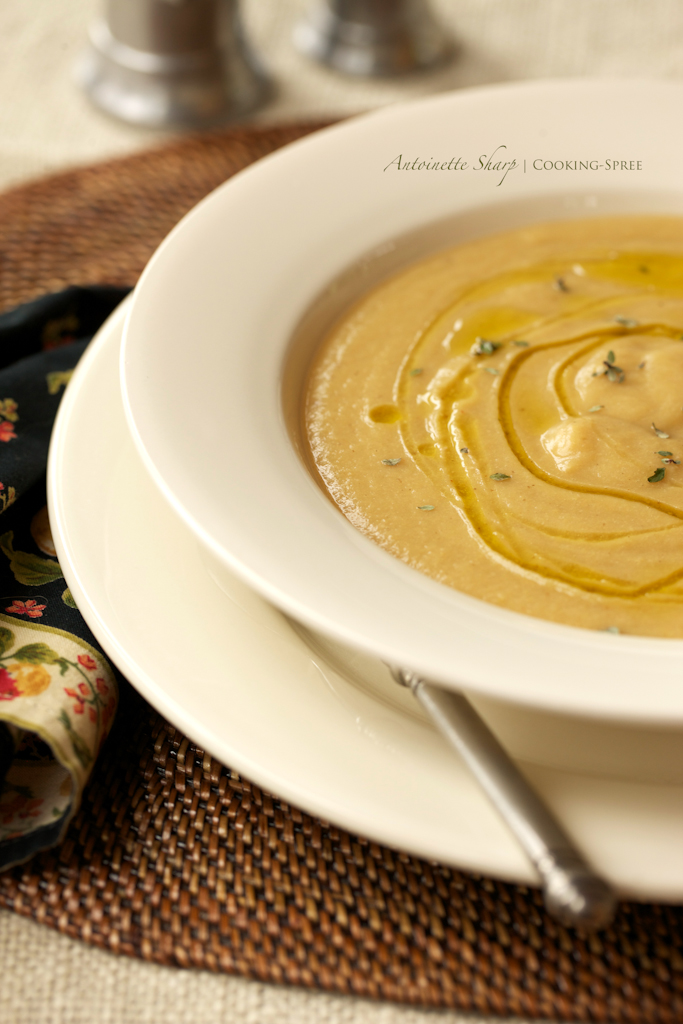
So, with very few words, may I simply offer you a bowl of luscious, comforting, healthful and delicious soup? Here, first…let me swirl my best olive oil on it. You deserve nothing less!

Chickpea Soup

4 servings

  • 2 cups (300 g) dried chickpeas
  • 1 medium onion, chopped
  • 1 garlic clove (or 2), chopped
  • 1 bay leaf
  • 1 fresh thyme sprig
  • a good pinch of cumin
  • a good pinch paprika
  • Chicken stock or vegetable stock (water is ok)
  • Salt & white pepper to taste
  • Your very finest olive oil (the one you’d serve the queen, or your future mother-in-law)

A day before, soak the beans in a large bowl. Fill with fresh cold water by several inches, and allow to sit overnight.

(I recently read – in Cook’s Illustrated – that if you add a ribbon of Kombu seaweed to your dried beans, you can actually do without the soaking, and it has a way of eliminating some of the side-effects as well as improving the texture of all beans cooked with it. I’ll try that next time. Too many words!) Read more

bread for tomorrow – the no-knead loaf

Did you know that ¼ teaspoon of yeast can rise a loaf’s-worth of dough just as well as a tablespoon? It’s true. It will simply take longer for it to do so. But there’s a real beauty in that. The old adage good things take time applies. With each extra hour the yeast grows, it adds incredibly to the flavor of the finished loaf. So, though some recipes for home-baked bread will have you adding nearly a tablespoon of yeast, and sugar for it to feast and grow quickly on, and have you rising the dough in a warm place, that’s meant for your convenience and to hurry the process. If you slow it down, you’ll love what happens!

This may be the easiest – and possibly one of the most delicious – breads you’ll ever bake. Start it today, finish it tomorrow, and there will be curtain calls and encores in your future! Do I exaggerate? Occasionally, I have, yes. But here, no.

For full-effect, a true Dutch oven is required f or this. Cast iron is best because it creates its own highly-conductive little furnace to bake the bread in. Higher-end brands like Le Creuset or Staub are lovely and come in many colors. But just as effective here are non-enameled (lidded) cast iron pots that you might see hanging over a campfire. The latter are inexpensive but require a bit more care in the cleaning, curing and preventing of rust. Always nice to have options though.

I’m sorry to repeat myself, but a digital kitchen scale makes this process so much simpler too, and with fewer things to clean up after. (See preceding posts if you haven’t already.)

This method (ingenious really) was first developed and introduced to us several years back by Jim Lahey of Sullivan Street Bakery in New York City. Since its introduction, this No-Knead method has rather revolutionized home bread-baking. Without terrifically expensive ovens (the kind of which are almost never seen in home kitchens), this bread’s crust wasn’t reproducible at home before. You can see for yourself though, loaves reminiscent of old-world bakeries can now emerge steamy and fragrant from our own rather ordinary ovens.The secret lies in the steam that’s created and contained within the Dutch oven as the bread bakes.

This bread will cost you the equivalent of 3 cups of good-quality flour. We won’t calculate the cost of ¼ teaspoon of yeast or a spoon of salt. Let’s just say this gorgeous bread costs less than a cup of coffee or tea (even a very bad cup.)

Let’s get started.

No-Knead “Artisan” Bread

and you are the artist!

  • 3 ¹⁄3 cups (430 g) flour (either all-purpose or bread flour)
  • ¼ teaspoon instant or active dry yeast
  • 2 teaspoon salt
  • 1½ cups  + 2 T (390 mL) water
  • Extra flour, wheat bran, fine cornmeal, as needed for dusting

a NOTE on the weight measurements, this primarily for the readers in the States who are as yet not as familiar as we will one day be with metrics. One beautiful thing about the metric system is that grams and mL’s are virtually interchangeable. In other words 100 mL’s of liquid will weigh 100 grams. Don’t you love that? That makes it possible to weigh out water measurements instead of the more approximate method of filling a glass measure where “a tad above-the line, below the line, eye-level” all makes a difference. Weighing is exact, every time.  (If you have a scale, it will likely convert US measurements to metric with a button-push, but just fyi 430 grams =  15.2 ounces.)

In a bowl, mix the flour, yeast and salt. Stir in the water to blend. If using a scale, place bowl on scale and zero it out. Add 430 grams flour. Add yeast and measure out salt. Zero the scale, and add 390 mL (or grams) of water. Mix loosely. (It will finish the process of blending as it sits.) What you’ll have will be a bit wet, shaggy and messy-looking. Cover bowl with a tea towel and allow to rest (and grow!) for 12 to 24 hours. (If you choose a cooler place, the process will likely take 18 to 24 hours. Room temperature, more like 12 hours.) When the dough is dotted with bubbles and very alive-looking, you’re ready for the next step.

Only 1/4 teaspoon yeast…amazing right?

Generously flour a work surface. Dump the contents of the bowl out onto it.

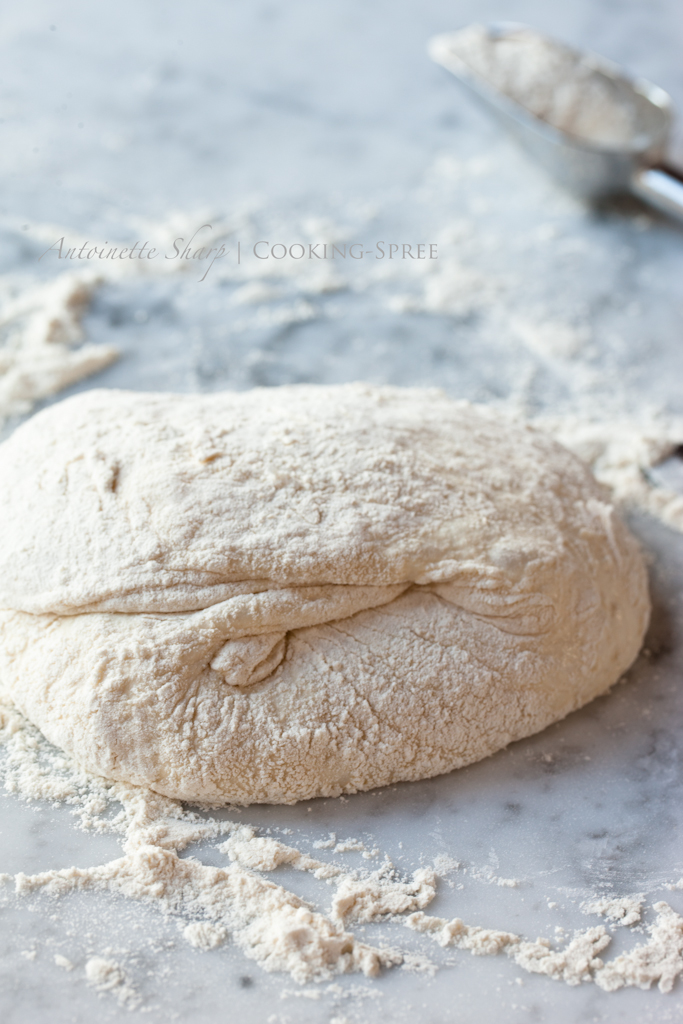
See all the strands of gluten that have formed while you’ve ignored your dough? This is what will create pockets to contain the gas.

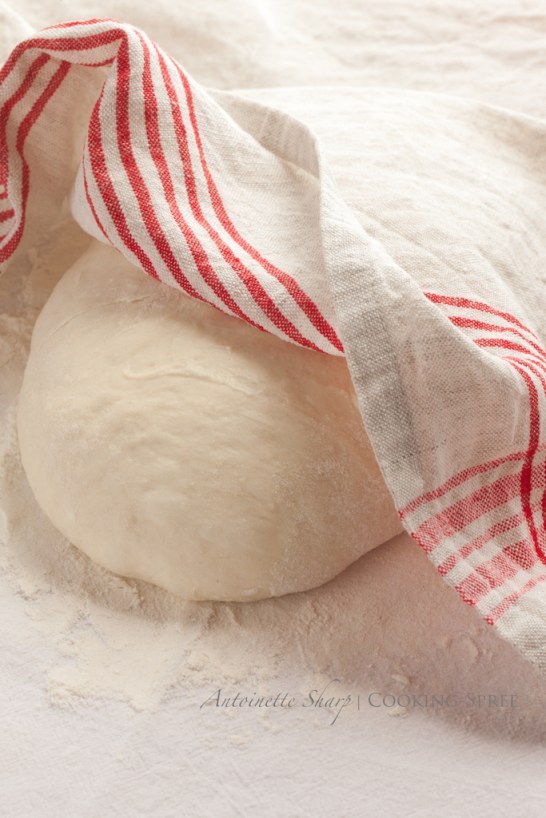
No need to knead, but simply fold the dough over on itself several times. Cover it with a clean towel and allow it to rest for 15 minutes. (Dough that rests like this is much more workable.)

(This next step feels so good!) Using only as much flour as needed to prevent the dough from sticking to your fingers, shape the dough as follows:

Fold in thirds (as if you were folding a letter for an envelope, one fold, then another.) Rotate the loaf, then fold each longer end in again. (You’ve made roughly a square shape with rounded corners.) What you have facing you is the seam that will open later, upon the final rise in the oven. 

After the first two folds

After the last two folds. Ready to rise.

Lie another towel on your counter and cover with a generous amount of flour, wheat bran or fine cornmeal and then place the dough on it, seam-side down. Be sure the flour extends beyond the borders of the bread as it will be growing. The reason for the generous amount of flour is that you do NOT want the bread sticking to the towel when you go to invert it into a hot Dutch oven.  Dust the dough with a little more flour then cover with a tea towel and allow to rise about 2 hours. In these two hours the bread will have more than doubled its size.  Read more

bread for today

It’s no secret: you can plunk down a lot of good money on a loaf of good bread. A loaf that actually tastes like bread, with honest texture and chew, with a browned crust that crackles when you tear or bite into it and little bits of it spill onto your lap. A loaf with a labyrinth of airy holes inside (to better hold the butter or olive oil), and an aroma that you want to bury your nose in. A loaf like that will set you back at least a several dollars.

Or – easy-as-pie (only easier) – you can make your own. In a recent post I listed bread from your oven as a remedy for the doldrums. It’s certainly that – but it’s not only the eating of it that lifts your spirits – it’s the feel of it, all squishy at first and then soft and powdery like a baby’s bottom. It’s the heavenly aroma that leaks from your oven and drifts through your house. And it’s the sheer miraculousness of motionless ingredients springing to life! Baking bread is simply one of life’s simple pleasures. Eating it is another.

In my previous post (on a grand scale) I laid out reasons why a digital kitchen scale belongs in your kitchen. For bread-making (as I’m about to describe) the process is made nearly fool-proof. You’ll get consistently wonderful results, loaf after steamy loaf. (The weight of “carefully” measured and leveled cups of flour can vary by as much as 2 ounces!)

The first of these two recipes will give you bread today. The second, using less yeast and undergoing a longer, taste-developing rise, can start today but will finish tomorrow. They’re both delicious, and I make each of them all the time. The second, if you can wait, is a-maz-ing! Both take very little hands-on time, the longer method even less hands-on time, so don’t be deterred by the waiting game. While the dough is doing its growing thing, you can be tending to whatever else calls you.

Almost always these days, I’ll bake bread using a Dutch oven. With its lid on, a moist mini-environment is created, one very similar to professional deck-ovens with steam-injection. The crust that results is phenomenal. I’ll give the instructions for with and without a Dutch oven. 

Basic Bread Dough

  • 20 ounces bread flour (4 cups)
  • 12 ounces water (1½ cups)
  • 2 teaspoons salt
  • 1 teaspoon active or instant yeast (I prefer active)

Instructions using a digital scale:

Turn scale on. If using a stand mixer to knead your bread, place its bowl on the scale and then zero the scale out. (The weight of the bowl will no longer be counted.) Begin scooping flour into the bowl until it measures 20 ounces. Measure in 2 teaspoon salt. Again, zero out the scale. Add lukewarm water until scale registers 12 ounces. Spoon 1 teaspoon yeast over the top and allow to dissolve in the water.

No scale yet? 

Measure the ingredients into your bowl by cup and spoon. (Never use a two-cup measuring cup to measure flour. The results are much more compact and will therefore weigh more than intended.)

Fit the bowl onto your mixer and using the paddle attachment, incorporate the ingredients fully. Remove paddle and replace with the dough hook. Knead until the dough is smooth and elastic. This will take about 10 minutes.

(When ready you should be able to remove a small piece of the dough and stretch between your fingers and it will stretch into a translucent sheet without breaking. If it quickly breaks, continue kneading. Another test is simply to use a couple knuckles to press the dough. If it springs back and completely fills the depression, it should be ready.)

Remove the bowl from the mixer, cover it with plastic and allow it to rise to about twice its size.

Now the test for readiness is to gently push a finger into the dough. The dough should offer some resistance. If it springs back rapidly, let it rest a bit longer. If you let it rise too long, the dough will turn a bit flabby and will be a bit more reluctant to give that extra rise once in the oven.)

Turn the dough out from its bowl onto a floured surface and knead it to expel excess gas and redistribute the yeast.

Forming the loaf:     Cover with a dish towel and let rest for 15 minutes. To form a boule (ball-shaped) loaf, simply roll the dough back and forth on the cutting board or counter following a circular motion until smooth and round. Again, cover the dough with a dish towel and allow to rise for another hour. If using a Dutch oven, you can place the boule in the pot and allow it to rise there. (But please refer to the Dutch oven method below before proceeding.) If using a traditional (no Dutch oven method) place the formed ball onto a baking sheet.
Traditional method (no Dutch oven)      After about 30 minutes of bread-rising –  Preheat the oven to 450°F.

(Yes, it’s early but the oven gets better, with a more even heat, if allowed to preheat for a longer period.) If you want to create some steam to produce a better crust you can place a cast iron skillet in the oven on a lower rack when you begin to preheat. Then add a cup of water to the skillet (using mitts to avoid burning!) when you put your bread in to bake.

Just before sliding your bread into the oven, slice an X or a pound symbol # into the top to help it expand for its final (rather dramatic) rise. Coat with olive oil and a sprinkling of coarse salt. Place into oven on baking sheet and bake for 10 minutes at 450°F then reduce oven temperature to 375°F and continue baking until done, 45 to 50 minutes. (Internal temperature when done, 200°F to 210°F.) Cool on a rack completely before cutting (if at all possible.)

Dutch oven method:  (5½- or 7½-quart Dutch ovens will work – best results with cast iron)

Don’t let this confuse you, but you have yet another option here. Either a pre-heated Dutch oven – the advantage will be a crunchier crust and a bit more rustic appearance, or a cold Dutch oven – the advantage being that you can allow your loaf to rise in the pan, preserving the pretty shape you’ve created. You might try them both and see which you like better. It’s slightly less “intimidating” if you start with the cold Dutch oven the first time. So I’ll begin there.

Cold Dutch Oven: After forming your boule (description above) place in the Dutch oven, the bottom of which has been oiled first. Allow to rise until doubled, then add a coating of olive oil and some coarse salt, and slash the top as directed above. Place the lid on the pot and bake for ½-hour. Remove the lid and continue baking until done. (The internal temperature will register 200°F to 210°F) another 15 to 30 minutes. Remove and cool on rack. The crust will make the most delicious-sounding crackle as it cools. (The loaf pictured here was prepared in a cold Dutch oven.)

Read more

post on a grand scale

Did you come here expecting some monumental piece of writing? Something brilliant, witty? Illuminating, perhaps life-altering? I disappoint. This is a simple post whose design is to make one simple point. You should have a kitchen scale.

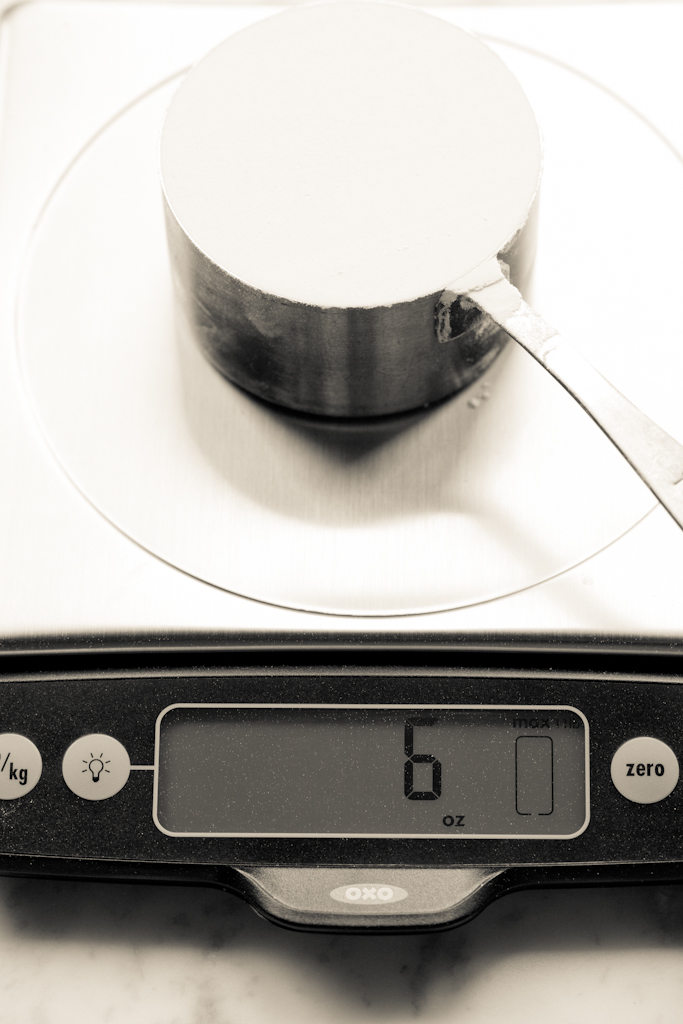
My argument is best made by illustration. Please notice how much one level cup of flour weighs.

 Turns out a level cup of flour can weigh anywhere from 4 to 6 ounces. (113 to 141 grams.)  (Most recipes written to include flour use 5 ounces as the standard.)

Turns out too (and this is no stretch) that a recipe can be a disappointing flop or a ravaging success based on which of those level cups you plopped into your bowl. That concludes argument #1.

Argument #2 may be even more compelling. You’ll have fewer bowls, measuring cups and spoons to wash. Having a kitchen scale simplifies your life!

Argument #3 – You may have noticed, more and more recipes are being written for weight measurements as opposed to volume. And some of those weights are actually METRIC. One day its bound to happen that we in the States will finally follow suit. A digital scale makes those conversions with the push of a little button. Life simplified!

Argument #4 – You will turn out loaf after loaf of gorgeous bread, each looking, feeling and tasting just as wonderful as the last one. (The next 2 posts will illustrate. Bread for Today, and then Bread for Tomorrow.)

But to give you a preview, it will go something like this –

You’ll get your scale out and set it on the counter.

You’ll turn it on, set a bowl on top, and zero the scale out. (This will result in the scale not accounting for the bowl’s weight, only the contents.) If you have a stand mixer with dough hook, use this bowl.

You’ll start scooping flour in until your scale indicates the correct weight needed – 5 ounces per cup.

You’ll zero the scale out again – now it will no longer account for the weight of the flour or the bowl.

You’ll begin pouring water into the bowl until the correct weight has registered.

Zero out the scale. Add yeast and salt in the same manner.

Knead with your machine, or by hand. Let rise. Form into ball (boule), let rise. Bake. Delight and eat! Delight some more!

This artisan-quality bread  is INCREDIBLY simple, RIDICULOUSLY inexpensive, and POSITIVELY wonderful! You will be SO happy you did this!

(stay tuned for the first of the two breads…)

preserved lemons

When winter hits, full force, my foodie mind turns to sunny foods. Bowls and platters of brilliant fruits (and vegetables) plucked straight from a Gauguin painting. Perfume-y spices from Morocco and India. And flowers, bright boisterous flowers dropping sunny pollen on the table.

Because that’s what my mind turns to, you’ll be seeing quite a few sun-drenched recipes here for the next couple months. Foods from Morocco, Spain, India, Provence, Italy, and  some island nations. I’m no authority on any of those cuisines – I simply know how I choose to cook, and how I love to eat, and I can’t resist the sharing when I stumble upon something wonderful.

A number of dishes will call for preserved lemon. For those of you unfamiliar, here’s what some chefs had to say about this well-loved and versatile condiment (also referred to as lemon confit):

 “…salt-preserved lemons have a strange and delectable flavor that utterly mystifies.”  [Nancy Harmon Jenkins, The Mediterranean Cookbook]

“…refreshing, tangy, essential to the cooking of tagines…well worth making your own….Be as liberal as you like, tossing them in salads and scattering them over your favorite tagines.” – [meat or vegetables stews] [that from Ghillie Basan, author of Tagine – Spicy stews from Morocco  and Flavors of Morocco]

Laura Calder, author of French Taste and delightful host of her own show on the Cooking Channel says:  “I don’t make tagines that often, so I have started flinging the lemons into other dishes… [Doesn’t that remind you a bit of Julia Child?] …Diced preserved lemon (and it’s actually the skin of the lemon you eat, not the flesh) is great with fish fried in butter or thrown in with nice fat chops to make a slightly exotic supper in a pan; it also perks up vegetable dishes.”

And here’s what Dorie Greenspan, author of the glorious cookbook, Around my French Table, has to say: “…soft…sharp…salty flavor…good with chicken and with meaty fish, like tuna and swordfish, they’re also wonderful with bitter greens and even beets.” 

Chef Eric Ripert of New York City’s famed Le Bernardin restaurant – “I add lemon confit to so many dishes—from broiled fish to pork and beans.”  He blends his lemon confit with butter to add a pleasantly pungent flavor to broiled fish. Before broiling, he’ll dot the fish with some of the lemon butter, then serve with more of it on the side.

~ ~ ~

You can of course find jarred preserved lemons already made – in some better-stocked grocery stores, gourmet shops or in Moroccan food markets. It’s very simple to make your own though, and inexpensive. Plus it kind of satisfies some pioneering itch inside, keeping your eye on that jar of lemons as they soften and mellow and transform themselves for your table. If you’re making your own, it does take about a month for them to fully “mature” – but they’ll last for perhaps a year in your refrigerator once done.

Preserved Lemons – or Lemon Confit

NOTE on the lemons: Because it’s only the rind you’ll be eating, it’s important (I think) to start with organic lemons.

  • 10 organic, unwaxed lemons (I prefer the smaller, thin-skinned, juicy and sweet Meyer variety)
  • 10 Tablespoons sea salt
  • the juice of 3 to 4 lemons, though possibly more (this juice doesn’t get used until day 3 or 4)


  • OPTIONAL: I like to add to each jar 1 or 2 bay leaves, several allspice berries, and 5 or six pink (or several black) peppercorns.

Wash (and then dry) your lemons and sterilize a quart-sized jar and lid.

(You have options on how to cut the lemons. Cutting in half cross-wise, or making longitudinal cuts from the top to about ¾ of the way to the bottom. I now prefer the latter way, so I’ll give instructions accordingly, though the photo below doesn’t agree.)

Cut the stem end and tips off of each lemon, top and bottom, avoid cutting into the lemon’s flesh. Standing the lemon on its bottom edge, slice from the top  ¾ of the way down, as if you were going to cut into quarters, but leaving the base intact. Read more

doldrums and remedies

dól-dremz – 1: a spell of listlessness or despondency   2: a state or period of inactivity, stagnation, or slump   3: in the Northern Hemisphere, the months of January and February, excluding special birthdays and Valentines Day.

rem-i-deez –  1: something that cures or relieves a disease or bodily disorder   2: something that corrects or removes an evil of any kind. 3. any one or all of the following:

a walk among trees…

love in your cup…

persimmons on your counter…

soup in your bowl…

dresses in a window…

Read more

awards & recommendations

On Christmas night, just as I was about to turn out the lights on the tree and head upstairs to bed, I went to tuck my computer to sleep. I didn’t realize it but I was about to open the final gift of the day. A comment had come through that Ronnie Hammer at Morristownmemos had nominated me for The Versatile Blogger Award. Thank you so much, Ronnie. Such an honor!

Ronnie herself was nominated. She writes of the everyday from a light-hearted and positive perspective, often with gentle humor. It’s been a pleasure getting to “know” her through her writing.

Complying with the rules of the award (that I’ve lazily copied from Ronnie’s site) – I have a few of my own nominations to make, some thank you’s to write and a few questions to answer. Forthwith – (do people still talk like that?)

Here are the rules for The Versatile Blogger Award:

1. In a post on your, blog, nominate 15 fellow bloggers for The Versatile Blogger Award.

2. In the same post, add the Versatile Blogger Award.

3. In the same post, thank the blogger who nominated you in a post with a link back to their blog.

4. In the same post, share 7 completely random pieces of information about yourself.

5. In the same post, include this set of rules.

6. Inform each nominated blogger of their nomination by posting a comment on each of their blogs.

~ ~ ~

Some of those I’m about to nominate have been nominated previously – some likely more than once – I hope they’ll forgive me for calling them out again. They’re too delightful for me not to mention. I’m fairly new in the blogosphere (only since April) and my feet feel just barely wet. I confess to not having a full 15 to nominate. (That’s got to be at least a 15-yard penalty!) Apologies made, let me now sing out (in no particular order) :

Lesley Treloar of Photo Journeys  – her photo work is simply exquisite, often exotic, and evocative. And Lesley travels the world, lucky for us!

Tanya at Chica Andaluza – witty, charming, endlessly creative!

Chicago John over at Bartolini Kitchens  – delightful, delicious, family stories and recipes to go along!

Greg & Katherine of Rufus’ Food and Spirits Guide – Greg (I’m quite sure) was the very first person outside my own circle to comment on a post I’d written. The team of them are prolific to say the least, and funny! Quick and uncomplicated recipes (for both food and spirits.)

Tinkerbelle, often hilarious, sometimes “shocking” – such fun reading.

Barbara (Smidge) over at Just a Smidgen – the epitome of versatility – cook, writer-poet, cellist, artist, humorist, and she takes some lovely photos. Hers is always a delight to read.

Roger of Camerahols/Food, Photography & France – extraordinary photography, both of food and the French countryside where he and his wife reside. Witty, intelligent writing. A Joy.

Natalie of Cook, Eat, Live Vegetarian – inspired recipes, lovely photography. (Natalie, like Tanya of Chica Andaluza, lives in Spain – considered the new center of the culinary world.) Her recipes are wonderful.

City, Hippy Farmgirl –  Fun, witty, clever, food & tales & photos worthy of your time!

In need of no call-outs from me, Brian of  The Blue Hour – lovely photography, sometimes hauntingly beautiful, stirs the imagination.

Savory Simple, gorgeous recipes from a professionally trained chef and gorgeous photos to match.

~ ~ ~

I think that concludes the list for the time-being. These are blogs I regularly follow and love. I’m sure my list of recommendations will grow as my horizons daily widen. There are other blogs I follow, some that I am enormously enriched, inspired and sometimes deeply touched by. For the purpose of this particular “assignment” though, I’m recommending blogs that are largely either food-  or photography-centric. And one that just makes me laugh. I thank them all for the lovely reads and the many eyefuls of beauty!

Seven random things about me? Seriously?

Read more

smokin’ hoppin’ john

From down south in New Orleans there comes a Cajun dish of black-eyed peas and rice, traditionally served on New Year’s Day. Hoppin’ John they call it. Eaten on the first day of the new year, it’s purported to bring good luck for the remainder. I figure when something tastes this good, it’s bound to be lucky! Most often made with ham and bones, this is a vegetarian version – don’t be dissuaded you meat-eaters – it’s brimming with smoky flavor from smoked paprika and chipotle peppers in adobo sauce.  (Now you see where the smokin‘ comes from.)

If you use frozen black-eyed peas and white rice, you could assemble this in well under an hour. And is it ever affordable! (With money saved….here I go with the pitch again…you could donate to a local food bank or shelter and help another eat well. That just may be doubly lucky.)

Smokin’ Hoppin’ John

makes 4 very generous servings

  • 2 Tablespoons vegetable or olive oil
  • 1 medium onion, coarsely chopped
  • 2 cloves garlic, minced
  • 1 cup uncooked medium- or long- grain rice (brown or white)
  • ½ teaspoon smoked paprika
  • 1½ cups dried black-eyed peas, soaked overnight, cooked and drained – or use a 20 oz. bag of frozen black-eyed peas for immediate use (see NOTE)
  • 2 – 3 cups vegetable both (or, if you prefer, chicken broth)
  • 1/4 cup beer
  • 1 chipotle chile in adobo sauce, minced
  • 1 t. salt

Optional Garnishes:

  • chopped green onions
  • grape tomatoes, cut in half
  • chopped fresh parsley
  • shredded cheddar
  • hot sauce (especially Cholula chipotle-style)

Soak black-eyed peas overnight.  Cover with water to level 2 inches above beans.  Gently simmer until done.  Drain and set aside. (If using frozen beans, simply proceed to the next step.)

NOTE: on the black-eyed peas. I have a preference for beans I cook myself. They hold together better, have just the perfect “doneness” and I think a bit more flavor. HOWEVER, frozen black-eyed peas make a totally acceptable alternative to cooking the long way and I wouldn’t hesitate to go that route if at all pressed for time.

Over medium heat, warm the oil in a large saucepan or heavy-bottomed pot.  Add the onion and cook until the onion is softened and sweaty, about 5 minutes.

Add the garlic and rice and stir well.  Allow rice to toast for 1 minute.  Add the smoked paprika and 1 teaspoon salt and stir to coat the mixture well. Read more