Easter morning

And whether or not you celebrate Easter, may this Sunday morning be full of light, warmth & good cheer,
and may there be love on, and all around, your table!
love, spree
Apr 8
And whether or not you celebrate Easter, may this Sunday morning be full of light, warmth & good cheer,
and may there be love on, and all around, your table!
love, spree
Apr 5
It’s time I told you of some plans. On Wednesday April 4th I’ll be heading out of town, gone for 9 days. Gone to meet, to hold and to fall in love with our family’s newest and littlest little. Besides nuzzling of soft powdery neck and losing my heart again, I’ll be preparing some meals, hiding-and-seeking, story-telling and tending to Ali, the littles’ mama.
In anticipation, yesterday was largely spent in the kitchen, making muffins (and more & more muffins) and two batches of granola. We’ll all be pretty busy at breakfast time, so a bowl of yogurt topped with fruit and crunchy granola, or nutritious muffins in one hand and baby in the other will put us one leg up on the day.
GratefulGuineaPig is out of town and comes home in the afternoon of the same morning I leave. Our ships will pass in the night, so I’ve left him some muffins for breakfast too.
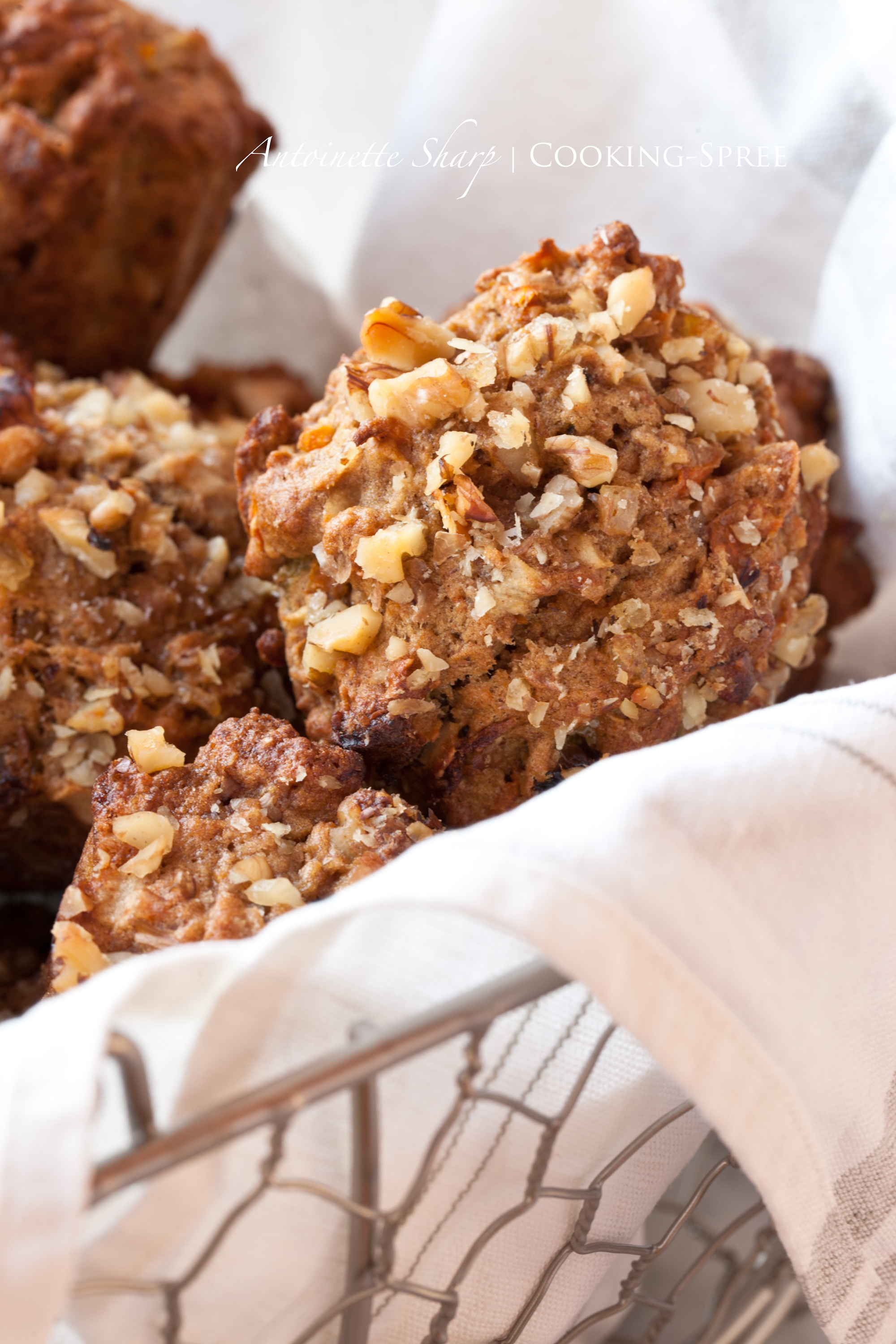
In the basket, Morning Glorious Muffins.
Earlier I posted a recipe for the above muffins. You can find them here.
But the muffin I’m about to share with you is ta-da G l u t e n F r e e. That matters to an increasing number of eaters out there. And what I’m discovering in sampling some of these g-f recipes is that the baked goods that result are extremely Tender & surprisingly Delicious! A number of them win the taste test over traditional flour recipes, with hands tied behind their backs. (I’d have lost good money if I’d bet on that one.) Here’s one plucked from the pages of La Tartine Gourmande that I thought you’d like!

Made with a combination of flours –
Quinoa flour – wheat-free, gluten-free, an ancient grain that adds a richness of flavor as well as a complete protein.
Millet Flour – one of the earliest cultivated grains (5,000 years ago in China!) it has a sweet flavor, high in amino acids and fiber and contributes a delicate, cake-like crumb to the baked goods it’s in. Again, easily digested and gluten-free.
Add in Gluten-Free Rolled Oats, tahini, grated apple, and this muffin packs a nutritional wallop and starts the day off right.
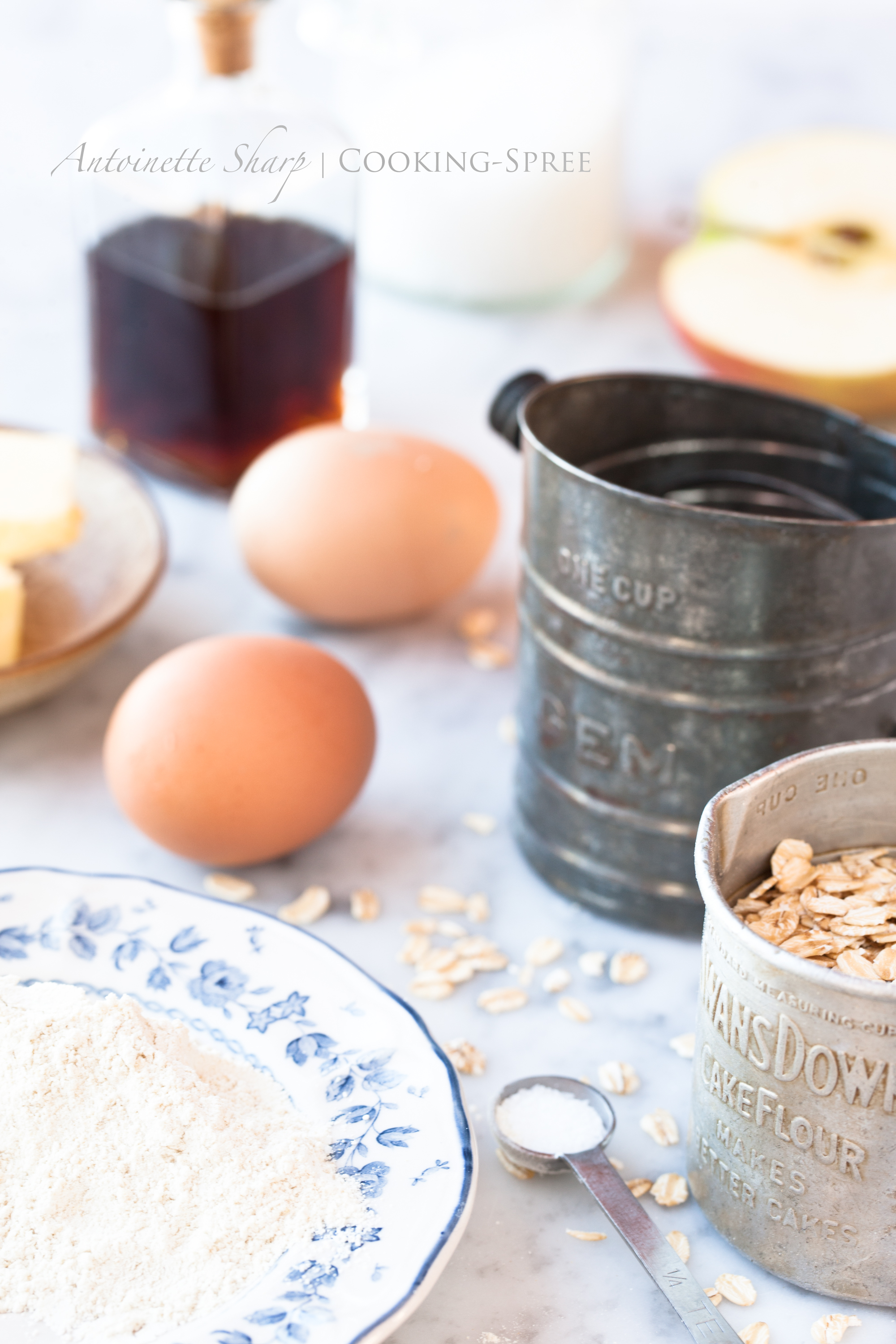
makes 10 muffins
 Preheat oven to 350°F (180°C). Line a muffin tin with 10 paper muffin cups, or use silicone muffin molds.
This bread has been a favorite around our house for years. There’s hardly ANY time at all in the actual preparation. No muscles required, no sporty (red or otherwise) stand mixer to pull out of its cupboard. Just a food processor and a couple simple ingredients and you’re in the bakin’ business. Of course, like all yeasted breads, there’s time spent loitering around. You design what form your loitering will take, but here’s how to make the bread – so easy, you might confuse it with play. First, I’ll give of all the instructions for the basic braided loaf (in the style of Challah, a Jewish egg bread.) Then I’ll show you how to adapt it so as to end up with a Greek-style festive Easter bread.
Glaze
1 large egg
½teaspoon salt
Bread:
1 scant Tablespoon dry Yeast (1 pkg)
3 Tablespoons Sugar
2/3 cup Water (105° to 115º F) —See NOTE
Bread Flour – 3 cups (15 ounces, 425 g) or more
¼ cup Safflower or other neutral-tasting oil — See NOTE on Ingredients
2 large Eggs
1 teaspoon Salt
Poppy or Sesame seeds (optional)
________
NOTE: Milk brought to temperature may be substituted for the water. Melted butter may be used in place of the oil. Both of these substitutions will result in a richer loaf.
(makes 2 loaves)
In the bowl of the processor, whir the egg and salt together, then pour into a small cup and reserve. No need to wash the work bowl.
This is the bread traditionally made for Greek Easter, and much like the one our Yaya would bring to the table.
Yaya’s kitchen had a converted wood oven, marbled-linoleum floors, tall ceilings covered in tin tiles, and smelled like nothing you’ve likely ever breathed — but should have! I remember, as a young girl, standing in her kitchen, watching in utter fascination as she – wearing an apron over one of her always-black dresses – would gently wrestle huge batches of dough, her stocky arms covered in flour, her hair wound in blonde-white braids around her head, her face serene. Four boys in that family, and they ate a lot of bread. And we did too, whenever we visited our Yaya and Papou.
I don’t have my yaya’s recipe for bread. But Yaya didn’t have or use recipes. How to make bread was in her body somewhere. She didn’t think it or measure carefully. She poured from glass bottles, scooped with bare hands, smelled and felt and knew when things were right.
This isn’t Yaya’s recipe, but it’s as close as I could come. It’s a brioche-type loaf – tender-crumbed, buttery, with a hint of anise and orange, absolutely delicious. The red egg is optional of course, but quite pretty nestled in its sesame-strewn, braided nest. If you decide to use one in yours, insert it between the twisted or braided ropes after it’s risen but before the egg-wash and sesame seeds have been added. You can insert the egg either uncooked or hard-boiled, but it’s typically not eaten after its baked with the bread.
In a separate post to follow tomorrow, I’ll be sharing a recipe for a – quick & easy – alternative to this loaf. It’s a Challah that I’ve made for years using the food processor, but with slight variations for this occasion.) 
the recipe can be doubled for 2 Tsourekia
Using a microplane zester if you have one, remove only the zest of ½ orange. Finely chop the zest and add it to the warm water and olive oil in the bowl of your mixer. Add the warm milk and combine well with a whisk. (It’s important that the zest be very fine here so as to fully infuse the bread with delicate flavor, but no chunks of peel. If you don’t have a microplane, I recommend you put the first three ingredients in a blender first, then add them, along with warm milk, to the bowl of your mixer.)
In a separate bowl, combine the ½ cup flour, 1 T. sugar, the yeast and salt. Add slowly to the wet mixture of the previous step, whisking as you go, until all is well-combined. Set in a warm draft-free place to proof for 20 minutes.
Fit the stand mixer with paddle attachment and return the bowl to the mixer. Turn on low speed, and slowly add the flour. (Yaya knew the amount of flour is always variable in a bread recipe. It’s going to depend on how you measure both wet and dry ingredients, the humidity, the size of your eggs, etc. Last time I made this, it took nearly 3 cups, but if you add too much, your bread will be lacking in tenderness, which would be such a shame! Add the final ½ cup gradually, as needed. You’ll want to add enough flour so that the dough pulls away from the sides of the bowl and starts to rise up on your beaters.The final dough should have the feel of a baby’s soft bottom. If that helps?? It’s really not tricky!)
Increase the speed of your mixer slightly and knead for 4 minutes until the dough becomes silky. (If you don’t have a stand mixer you can do all of this by hand. Because there’s no whole-grain in this recipe, this is not a difficult one to knead – and there are times when kneading just feels so right!) Take the dough and all its little bits from the bowl, form into a nice ball and return it back to the bowl to rise. Cover and set in a warm place to double – about 40 minutes. (One nice environment is in your oven – no heat! – just fill another bowl with hot water and put it inside the oven along with your bowl of dough. Or you can rest it on a sunny ledge – if you live in one of those places where the sun shines!)
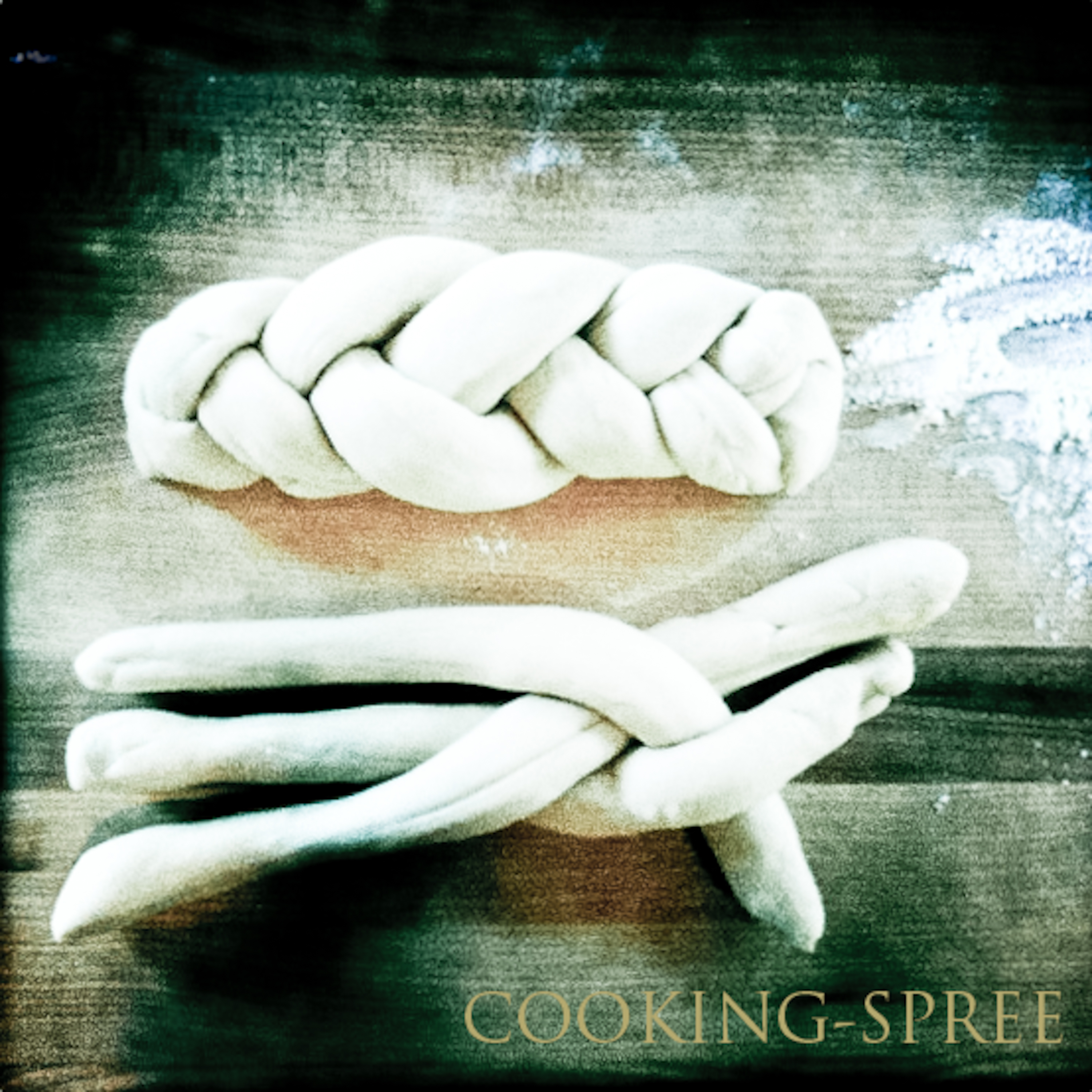
Turn the dough out onto a very lightly floured board. (Or if you like, you can lightly grease it instead.) Roll into a long rope with your hands. Pick up the two ends of your ropes and set them down close to you. Now, just draw one end of the rope over the other, then under, then up over again. (All you’re really doing is making two complete twists.) Gently squeeze the ends together.
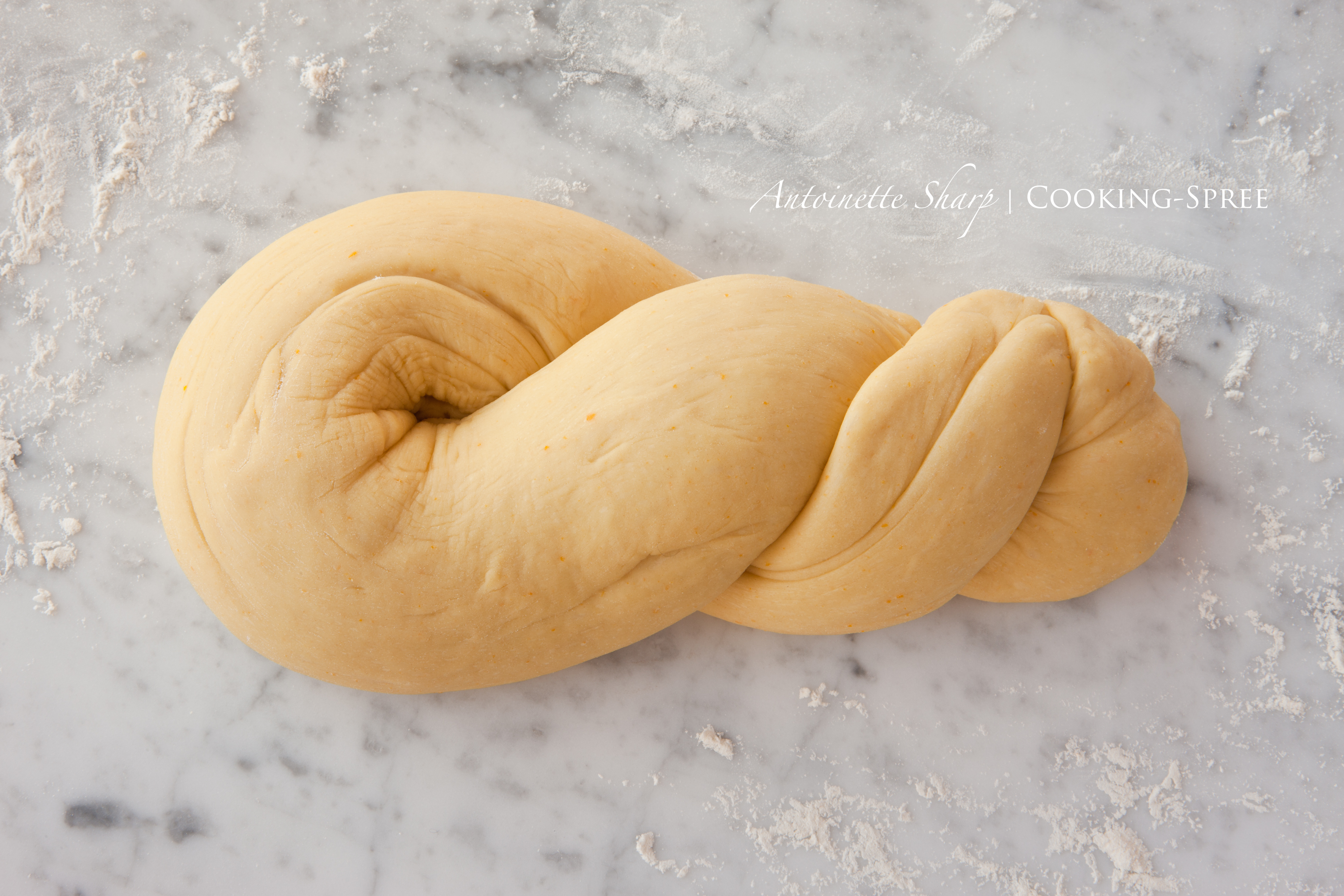 The halfway mark where you first folded the rope is where the egg will eventually nestle. But not yet. Place on a baking sheet lined with parchment paper. Cover and set in a warm place to double in size, another 40 minutes to an hour approximately.
Apr 1
It is told, that in a time long ago, among the rock-strewn hills of Greece, a young woman was seen walking to market, carrying a basket of eggs she’d collected. The hems of her skirts were dusty. Her shoulders were stooped, her step was slow and heavy. Her face bore a great sadness. A group of men passing by stopped to ask, with concern, “Why so sad, lady?”
“Have you not heard?” she answered, surprised at their ignorance. “Christ our Lord has died and been buried!”
“Have YOU not heard?!” they asked, amazed.”Christ was buried, but He has risen!”
“Risen? from death? This can’t be! If you speak the truth, may these eggs I carry turn red!” And before her very eyes, they did. Her basket of pearl white eggs had suddenly turned brilliant scarlet. And she, now believing the news she’d been given, exclaimed, “He has risen! Indeed, He has risen!” And she ran home to tell the news.
“Χριστοσ Ανεστο!” (Christos anesti!)

Our father grew up, and married our mother, in the Greek Orthodox Church. Up until the time they married, Easter at our house was overseen by the big Bunny, who, along with whichever of his assistants he called upon, hid the eggs and filled our baskets with jelly beans, chocolates and crayons. We loved it – of course. But when our Dad entered our lives, carrying with him his wonderful Greek traditions and the stories to explain them, suddenly, Easter had a meaning. In Greek culture, traditions around Easter are especially rich. As our Yaya would say to Mom, “Is not so big Jesus was born, Ruth. Is big He rose!” Of all the Saints’ Days and all the other religious holidays they celebrate, without question, Easter is supreme. There’s no holiday more festive, more family-oriented, nor is there one in which the people feast as long, as much and as happily as they do on Greek Easter.
Easter in the Greek Orthodox Church frequently falls on a date different than the one on most calendars, so our family celebrated twice!
Only some of the traditions made their way into our lives, but those traditions have stuck, now into the fourth generation since Yaya. And the Scarlet Egg from the story plays a starring role.
First, let me begin by saying, it’s no small feat to turn a white egg scarlet. You may get a lovely shade of bright pink, but honestly, are we impressed? In a photo below, you’ll see the packet of dye I used this year. I picked it up at the local Greek deli (Foti’s in Portland) where our Dad used to buy the feta and olive oil, and where my brother and I sometimes have lunch. When I left the shop with the packet of dye in hand, the owner wished me good luck! And I knew what he meant. As important as it is that the eggs be red, the real challenge is yet to come!

Mar 29
With Easter 10 days away, now seems like a good time to talk
Separating whites from yolks – contrary to what you watched your mother do, it’s not the best idea to separate using the shell. Why? Eggs can transport that nasty nasty salmonella bacteria – where would you see those little uglies lurking? yup. The shell.
A better (safer) way – there are several:
1. Use your (clean) hands – break the egg into the palm of your hand, gradually open your fingers enough to allow the white to slip between them into the bowl beneath, while the yolk stays put. 10-year-old Sicily especially loved this method! It’ll work even better when her hands are 12. 🙂 Wash your hands well after. I know, not YOU, but somebody out there’s going to forget, lick their fingers and get real ugly-sick.
2. Break the whole egg into a bowl. Using a slotted spoon, dip into the bowl, lifting the yolk and gently transferring to a separate bowl. (Don’t try to do this with multiple eggs at once, unless … well, just don’t.)
3. Use a slotted tool specifically made for this purpose. There are a number of them on the market if that’s your pick. From $6.00 to something ridiculously more. While on topic, I must include this : years ago my sister-in-law bought me an oogley critter-head, cup-shaped, made of pottery. It has a rather wide frowning slit for a mouth. Break the egg inside, tip him over a bowl and he drools egg whites.
I alternate between using my hands and the ogre. My psychiatrist thinks I was repressed as a child and wasn’t allowed to play with my food enough. But honestly, who DID? Good news: I’m on meds. They’re helping. 😉 Would love to hear your method.
The perfect hard-boiled egg –
Mar 26
Why we love our cast iron pans – they’re one of the most affordable pans on the market ~ they conduct & maintain heat incredibly well ~ are great for high-heat situations such as frying and searing ~ working on stove-top or oven, gas, electric or induction, even on the grill ~ they go camping with us ~ they’ve been around forever and have a certain nostalgic charm ~ and when cared for properly, they’re virtually indestructible, non-stick, and something your someday-grandkids will love to have.
Caring for the cast iron pans we love – to clean stubborn food remnants: SALT & a bit of OIL! (Don’t use soap.) Kosher salt (Morton’s is cheap, coarse and great for this purpose.) With the pan still warm, add ½ to 1 cup of coarse kosher salt and a touch (maybe 1 teaspoon) vegetable oil. Using a rag or folded dishcloth you reserve for this purpose, scour the pan. Rinse with hot water and dry immediately. (You can clean up with far less salt if your pan isn’t coated with food. A little salt and paper towel may do the trick.)
Seasoning the pans we love – nothing could be simpler. Rub a light coat of vegetable oil into the clean pan, about a Tablespoon for a larger skillet (flaxseed or grapeseed work especially well), starting with the inside, with anything remaining on the cloth continuing to the outside also; place in a low-temp oven (say 250°F for ½ to 1 hour). The heat will help the pan absorb the oil. A well-seasoned pan will perform better (especially as a non-stick surface) and will greatly resist rust that iron is otherwise prone to.
Oh, you’ve not heard of it? Spreezza’s that immensely popular little dessert pizza, covered with marscarpone cheese, topped with juicy fresh fruits, drizzled with some delectable sauce or other, some even scattered with herbs. Oh, you’ve not heard of them? I guess I must have made it up.

It begins with a good pizza dough….
This No-Knead Pizza Dough is bubbly, chewy, crispy and better than you’ll find at most pizza parlors. It can be used for ALL manner of pizzas – nothing at all about it restricts it to the dessert realm – in fact I’m the one who’s taken it there. It’s a take on the now-famous No-Knead Bread of Jim Lahey (owner of Sullivan St. Bakery in NYC) who introduced it a number of years back to rave reviews. I posted the bread late last year but if you missed the post and would like to take a look, you can check it out here. This pizza dough, like the bread that inspired it, derives its wonderful complex flavor from its overnight fermentation. So the only thing you have to consider moving forward is to start it the day before you plan to enjoy it.
Now if you’ve got a hankering for a spreezza and you don’t want to wait til tomorrow, you can always begin with a store-bought dough (Trader Joe’s has a very good one), skip all this that I’m about to tell you about the dough, and move quickly to the spreezza recipe further down. But you might want to return to this dough another time, because it really is wonderful.
~ ~ ~
(Each of the following 10 to 12″ pizzas will make about 4 portions of dessert, 2 slices per person. About the same amount would hold true if being served for brunch with accompanying eggs and/or meats and other items. For breakfast, I’d allow more per person…maybe half a Spreezza per person. You can halve the recipe easily if you like. Or make the whole thing, break it into portions, wrap and refrigerate for up to 3 days to use in other ways…like a traditional pizza. Or stay tuned because I’ve got another fun idea coming up very soon! Flavor and texture of the dough will not suffer at all for the extra time spent in the fridge. If you want to wrap and chill ahead, just allow 2 to 3 hours once they come out of the fridge for unwrapped dough balls to rest before forming into pizza pies.)
makes six 10″ to 12″ pizzas
(about 20½ hours, with only 90 minutes active time)
makes three 10″ to 12″ pizzas
Whisk flour, salt and yeast in a medium bowl. While stirring with a wooden spoon, gradually add 3 cups water (1½ cups if halving the recipe!). Stir until well incorporated. Mix dough gently with your hands to bring together and form into a rough ball. Transfer to a large clean bowl. Cover with plastic and allow the dough to rise at room temperature in a draft-free place until the surface is covered with tiny bubbles and dough has more than doubled in size. About 18 hours time, though time will vary depending on the temperature of the room. 
Transfer dough to a floured work surface. Gently shape into a rough rectangle. Divide into 6 equal portions (or 3 if halving the recipe.) Working with 1 portion at a time, gather 4 corners to the center to create 4 folds. Turn seam-side down and mold gently into a ball. Dust the dough with flour; set aside on the work surface or floured baking sheet, and repeat with the remaining portions.
Let the dough rest, covered with plastic wrap or a damp kitchen towel, until soft and pliable, about 1 hour.
During the last hour of the dough’s resting, prepare the oven. If using a pizza stone, place a rack in the upper third of the oven, put the pizza stone on it and preheat oven to its hottest setting, 500° – 550°F (260° – 290°C.) (If using a baking sheet, no need to preheat that.)
Working with 1 dough piece at a time, dust the dough generously with flour and place on a floured work surface. Gently shape the dough into a 10″ to 12″ disk (25-30 cm.)

If using a pizza stone – Sprinkle a pizza peel or rimless (or inverted rimmed) baking sheet lightly with flour. Place dough disk on the peel or prepared baking sheet, and, using back-and-forth movements, slide pizza from peel onto the hot pizza stone. Bake the pizza, rotating halfway through, until the bottom crust is crisp and the top is blistered, about 5 – 7 minutes total. If using this pizza dough for a Spreezza, brush with melted butter when you rotate the pizza.
(pronounced spreé-tza)
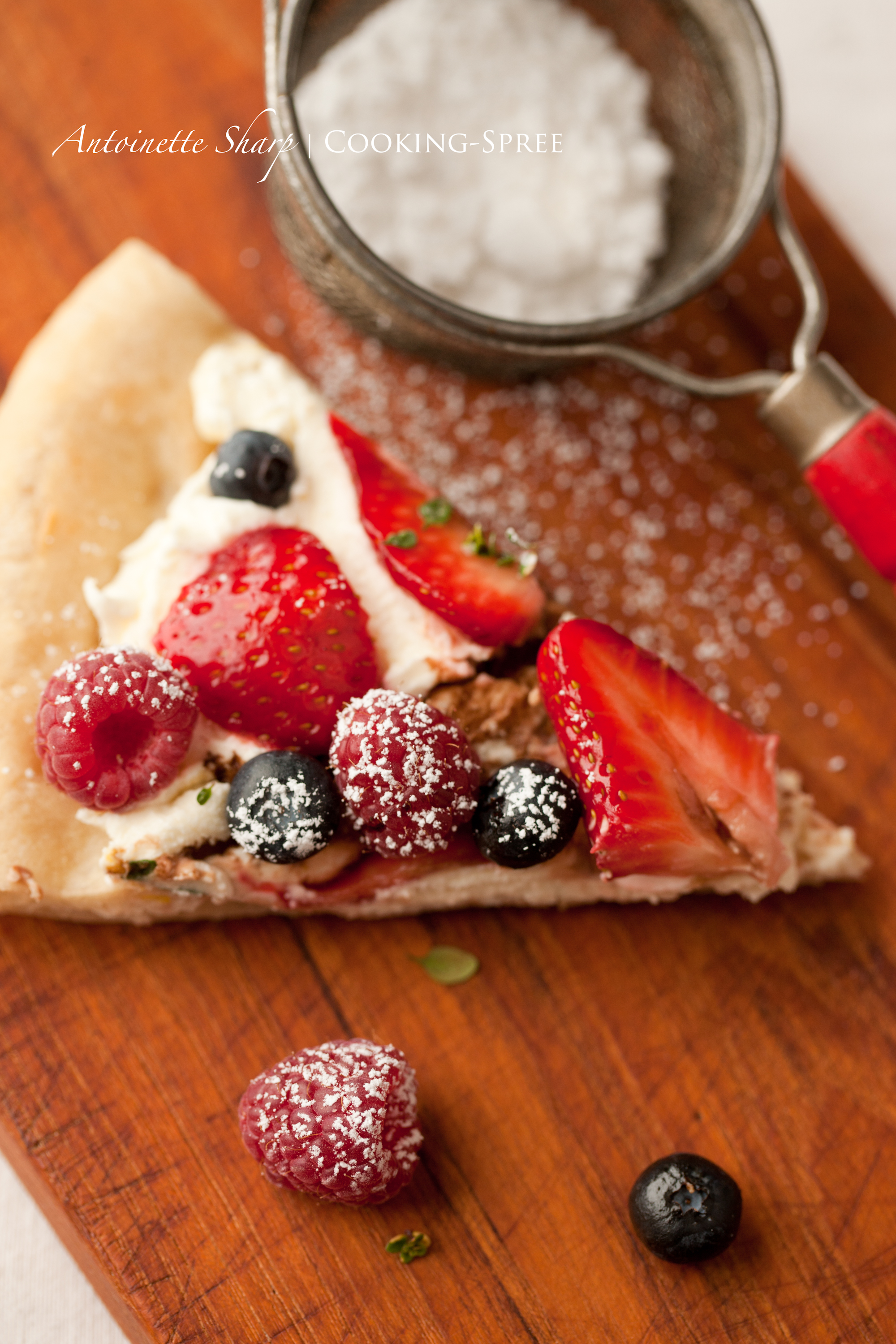
Now, here is where this whole thing turns so fun! I’ll give guidelines for 2 versions here. I’ll share others as seasonal fruits appear. This isn’t science. This isn’t hard-and-fast measurements. This is Playing with Food!
for each 10-12″ pizza, you will want – approximately:
~ ~ ~ Read more
Mar 13
It’s snowing big fluffy rabbits here today. Went to bed with rain pouring thunderously on our roof so loud we could barely hear one another, but woke to 5 inches of pristine white silence covering our patio. So, out of exhilarated appreciation for the quiet beauty of this day, I’m keeping it white.
Have you ever enjoyed buttermilk, freshly bottled from a local dairy? When I was girl, my grandfather (we called him Big Papa and he was indeed bigger than life in many ways) had a dairy farm on the coast in Washington state. Sweet-faced Jersey cows, each one with a name, would line up in the milking barn twice a day. One of these days I’ll share some stories of what life on that farm was like. It was so much MORE than a dairy farm, but I don’t want to give it all away in a little Spreenkle. I remember though, on the tile counter of the old farm house, sat bottles of milk, their skinny necks filled with the sweet cream that had risen. And I remember too the taste of fresh buttermilk our grandma would make. And occasionally a treat. A milkshake maker, the color green of the day, with its cloth-covered cord and its dented steel container would be pulled from its cupboard and set on the counter. Into it went fresh, chilled whole-buttermilk and orange sherbet. Whirrrr! Pour! Straw! Slurp! Pure deliciousness!
It’s not easy to find a truly wonderful buttermilk in our markets. But we can Make it! And it’ll be wonderful. I’m not talking here about the “trick” of adding vinegar or lemon juice to milk to simulate the real thing when we’ve run out. Read more


 cooking-spree
