Skip to content

Posts tagged ‘photography’

10 little monkeys

A game of tag is circulating the blog world and I’ve just been snagged…by Kathryn, a playful little monkey who asked that I play along. I’m game!

That being said, I have a rule-breaking streak in me…I’m squirming here, itching to break free and add a few questions of my own. I’m not one who likes the confinement of narrow boxes. 

But – also being a bundle of contradictions, as most of us are – I’m generally amiable and play by the rules. Here are the questions I was asked and I’ll do my best to stop squirming.

1.  Describe yourself in seven words.

joyful….soft-hearted….adventurous….passionate….lover-of-life….positive….thankful.  Above all, I think…thankful!

2.  What keeps you up at night?

How much time do you have??? My short answer: a mind that frolics. It loves words, and from them it makes up all kinds of sentences that lead to all kinds of scenarios, some amusing, others quite boring and repetitious. My mind tries dancing while my body tries sleeping. They’ve been doing this for years.

3.  Whom would you like to be?

oh, only me. (not that I’d recommend that for anyone else, no, I wouldn’t!)

I was a bit of a late bloomer, and I’m still figuring it out, this blooming thing. But I’m getting closer. Not by leaps and bounds, but by hops and skips, and now that I’ve started down this path, I have no interest in turning back. And as poor a job as I’ve done at being me at times, I’d do an even worse job at trying to be someone else. For now, I’m content to keep skipping down my own path.

4.  What are you wearing now?

I’ll be right back.

I’m wearing the loveliest cashmere sweater, a hand-painted silk scarf, a curve-hugging skirt with a (just-barely-tasteful) slit up the side, tall tall boots,

(who am I kidding. I dress in clothes that feel good. Which is not to say frumpy, never frumpy! No sweatpants in this closet. But I’m cozy-comfily dressed. Really, who wants more information than that?)

5.  What scares you?

Losing the thing that keeps me up at night. I’ve gotten used to a mind that frolics.

6.  What are the best and worst things about blogging?

The best: words and images and the  J O Y  of weaving them together. And the completely unexpected best: the joy of friendships formed and forming! Of this, I had no idea.

The worst: pushing “publish” and then thinking, oh that was stupid. that was idiotic. why did you say that? what were you thinking? what will they think? why don’t you just quit this whole thing and go back to life as it was – it was good! That’s pretty much it in a nutshell. Self-doubt.

7.  What was the last website you looked at?

American Hunter Woman – hah! got you didn’t I?

8.  If you could change one thing about yourself what would it be?

Self-doubt.

9.  Slankets, yes or no?

I must be so old! What the heck is a slanket? But I guess I’ll say no. I don’t like the sounds of that at all. Read more

a simple post on a simple, luscious soup

dear readers, after the last two posts and all those   w o r d s   I must have bored you to teary yawns! Don’t think I don’t care about such things. I’m the first second to recognize you deserve a break!

So here, just one simple recipe, one photo and very few words from spree.

(I can’t launch into this recipe without first telling you –  I am so incorrigible! – that a recent study names beans as one of the top food categories implicated in promoting brain health into old age. The recommendation was for one to two servings per week (at a minimum.) Along with them,  the “super foods”. You know the ones.)

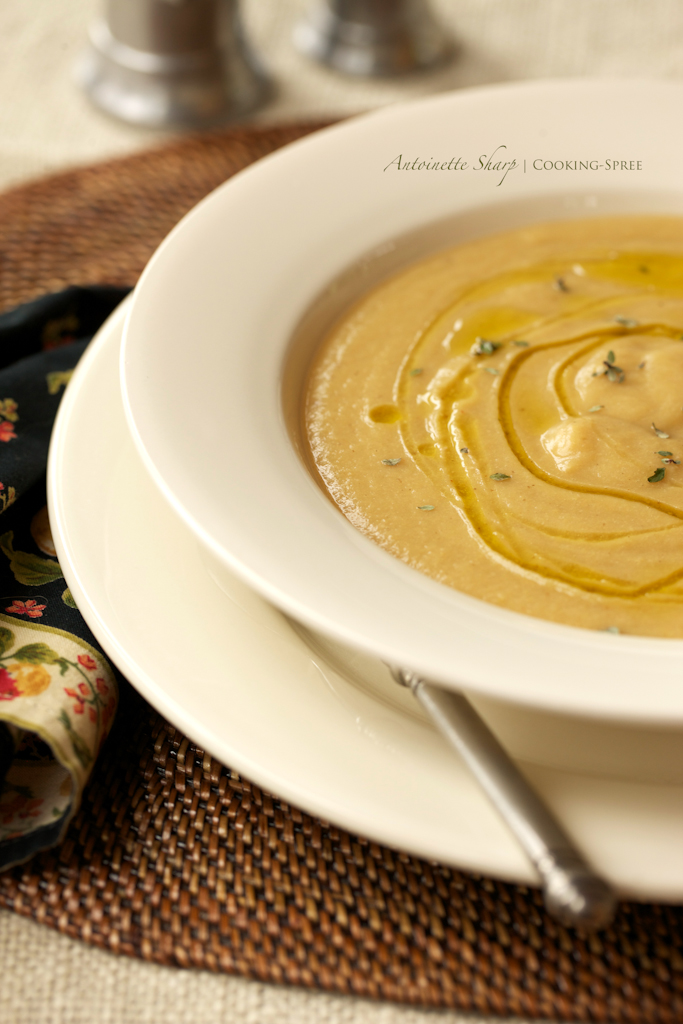
So, with very few words, may I simply offer you a bowl of luscious, comforting, healthful and delicious soup? Here, first…let me swirl my best olive oil on it. You deserve nothing less!

Chickpea Soup

4 servings

  • 2 cups (300 g) dried chickpeas
  • 1 medium onion, chopped
  • 1 garlic clove (or 2), chopped
  • 1 bay leaf
  • 1 fresh thyme sprig
  • a good pinch of cumin
  • a good pinch paprika
  • Chicken stock or vegetable stock (water is ok)
  • Salt & white pepper to taste
  • Your very finest olive oil (the one you’d serve the queen, or your future mother-in-law)

A day before, soak the beans in a large bowl. Fill with fresh cold water by several inches, and allow to sit overnight.

(I recently read – in Cook’s Illustrated – that if you add a ribbon of Kombu seaweed to your dried beans, you can actually do without the soaking, and it has a way of eliminating some of the side-effects as well as improving the texture of all beans cooked with it. I’ll try that next time. Too many words!) Read more

bread for tomorrow – the no-knead loaf

Did you know that ¼ teaspoon of yeast can rise a loaf’s-worth of dough just as well as a tablespoon? It’s true. It will simply take longer for it to do so. But there’s a real beauty in that. The old adage good things take time applies. With each extra hour the yeast grows, it adds incredibly to the flavor of the finished loaf. So, though some recipes for home-baked bread will have you adding nearly a tablespoon of yeast, and sugar for it to feast and grow quickly on, and have you rising the dough in a warm place, that’s meant for your convenience and to hurry the process. If you slow it down, you’ll love what happens!

This may be the easiest – and possibly one of the most delicious – breads you’ll ever bake. Start it today, finish it tomorrow, and there will be curtain calls and encores in your future! Do I exaggerate? Occasionally, I have, yes. But here, no.

For full-effect, a true Dutch oven is required f or this. Cast iron is best because it creates its own highly-conductive little furnace to bake the bread in. Higher-end brands like Le Creuset or Staub are lovely and come in many colors. But just as effective here are non-enameled (lidded) cast iron pots that you might see hanging over a campfire. The latter are inexpensive but require a bit more care in the cleaning, curing and preventing of rust. Always nice to have options though.

I’m sorry to repeat myself, but a digital kitchen scale makes this process so much simpler too, and with fewer things to clean up after. (See preceding posts if you haven’t already.)

This method (ingenious really) was first developed and introduced to us several years back by Jim Lahey of Sullivan Street Bakery in New York City. Since its introduction, this No-Knead method has rather revolutionized home bread-baking. Without terrifically expensive ovens (the kind of which are almost never seen in home kitchens), this bread’s crust wasn’t reproducible at home before. You can see for yourself though, loaves reminiscent of old-world bakeries can now emerge steamy and fragrant from our own rather ordinary ovens.The secret lies in the steam that’s created and contained within the Dutch oven as the bread bakes.

This bread will cost you the equivalent of 3 cups of good-quality flour. We won’t calculate the cost of ¼ teaspoon of yeast or a spoon of salt. Let’s just say this gorgeous bread costs less than a cup of coffee or tea (even a very bad cup.)

Let’s get started.

No-Knead “Artisan” Bread

and you are the artist!

  • 3 ¹⁄3 cups (430 g) flour (either all-purpose or bread flour)
  • ¼ teaspoon instant or active dry yeast
  • 2 teaspoon salt
  • 1½ cups  + 2 T (390 mL) water
  • Extra flour, wheat bran, fine cornmeal, as needed for dusting

a NOTE on the weight measurements, this primarily for the readers in the States who are as yet not as familiar as we will one day be with metrics. One beautiful thing about the metric system is that grams and mL’s are virtually interchangeable. In other words 100 mL’s of liquid will weigh 100 grams. Don’t you love that? That makes it possible to weigh out water measurements instead of the more approximate method of filling a glass measure where “a tad above-the line, below the line, eye-level” all makes a difference. Weighing is exact, every time.  (If you have a scale, it will likely convert US measurements to metric with a button-push, but just fyi 430 grams =  15.2 ounces.)

In a bowl, mix the flour, yeast and salt. Stir in the water to blend. If using a scale, place bowl on scale and zero it out. Add 430 grams flour. Add yeast and measure out salt. Zero the scale, and add 390 mL (or grams) of water. Mix loosely. (It will finish the process of blending as it sits.) What you’ll have will be a bit wet, shaggy and messy-looking. Cover bowl with a tea towel and allow to rest (and grow!) for 12 to 24 hours. (If you choose a cooler place, the process will likely take 18 to 24 hours. Room temperature, more like 12 hours.) When the dough is dotted with bubbles and very alive-looking, you’re ready for the next step.

Only 1/4 teaspoon yeast…amazing right?

Generously flour a work surface. Dump the contents of the bowl out onto it.

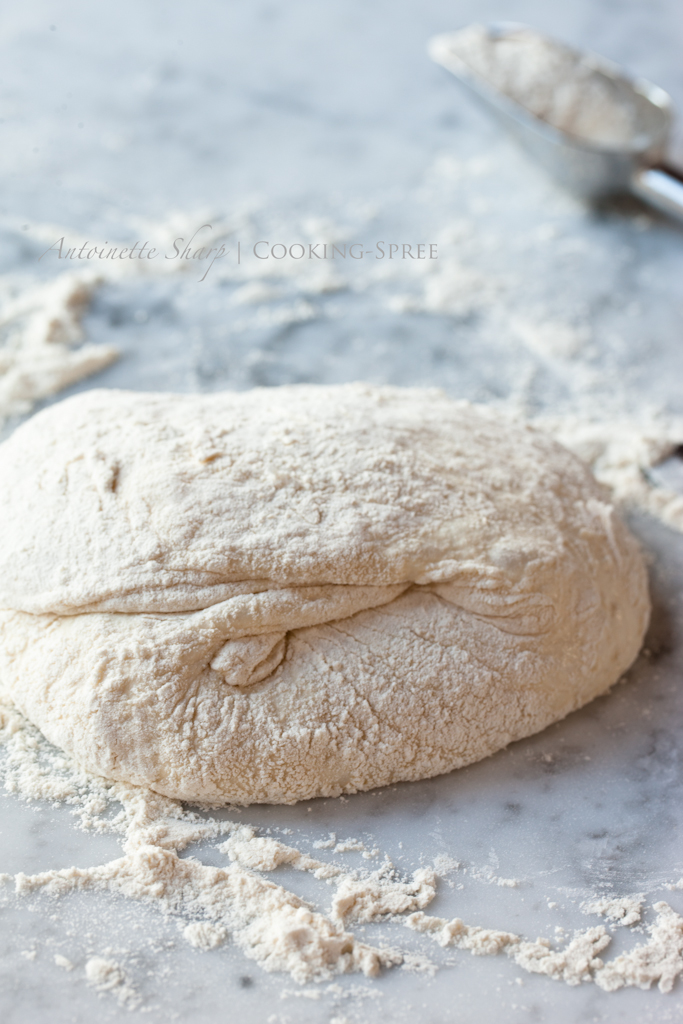
See all the strands of gluten that have formed while you’ve ignored your dough? This is what will create pockets to contain the gas.

No need to knead, but simply fold the dough over on itself several times. Cover it with a clean towel and allow it to rest for 15 minutes. (Dough that rests like this is much more workable.)

(This next step feels so good!) Using only as much flour as needed to prevent the dough from sticking to your fingers, shape the dough as follows:

Fold in thirds (as if you were folding a letter for an envelope, one fold, then another.) Rotate the loaf, then fold each longer end in again. (You’ve made roughly a square shape with rounded corners.) What you have facing you is the seam that will open later, upon the final rise in the oven. 

After the first two folds

After the last two folds. Ready to rise.

Lie another towel on your counter and cover with a generous amount of flour, wheat bran or fine cornmeal and then place the dough on it, seam-side down. Be sure the flour extends beyond the borders of the bread as it will be growing. The reason for the generous amount of flour is that you do NOT want the bread sticking to the towel when you go to invert it into a hot Dutch oven.  Dust the dough with a little more flour then cover with a tea towel and allow to rise about 2 hours. In these two hours the bread will have more than doubled its size.  Read more

bread for today

It’s no secret: you can plunk down a lot of good money on a loaf of good bread. A loaf that actually tastes like bread, with honest texture and chew, with a browned crust that crackles when you tear or bite into it and little bits of it spill onto your lap. A loaf with a labyrinth of airy holes inside (to better hold the butter or olive oil), and an aroma that you want to bury your nose in. A loaf like that will set you back at least a several dollars.

Or – easy-as-pie (only easier) – you can make your own. In a recent post I listed bread from your oven as a remedy for the doldrums. It’s certainly that – but it’s not only the eating of it that lifts your spirits – it’s the feel of it, all squishy at first and then soft and powdery like a baby’s bottom. It’s the heavenly aroma that leaks from your oven and drifts through your house. And it’s the sheer miraculousness of motionless ingredients springing to life! Baking bread is simply one of life’s simple pleasures. Eating it is another.

In my previous post (on a grand scale) I laid out reasons why a digital kitchen scale belongs in your kitchen. For bread-making (as I’m about to describe) the process is made nearly fool-proof. You’ll get consistently wonderful results, loaf after steamy loaf. (The weight of “carefully” measured and leveled cups of flour can vary by as much as 2 ounces!)

The first of these two recipes will give you bread today. The second, using less yeast and undergoing a longer, taste-developing rise, can start today but will finish tomorrow. They’re both delicious, and I make each of them all the time. The second, if you can wait, is a-maz-ing! Both take very little hands-on time, the longer method even less hands-on time, so don’t be deterred by the waiting game. While the dough is doing its growing thing, you can be tending to whatever else calls you.

Almost always these days, I’ll bake bread using a Dutch oven. With its lid on, a moist mini-environment is created, one very similar to professional deck-ovens with steam-injection. The crust that results is phenomenal. I’ll give the instructions for with and without a Dutch oven. 

Basic Bread Dough

  • 20 ounces bread flour (4 cups)
  • 12 ounces water (1½ cups)
  • 2 teaspoons salt
  • 1 teaspoon active or instant yeast (I prefer active)

Instructions using a digital scale:

Turn scale on. If using a stand mixer to knead your bread, place its bowl on the scale and then zero the scale out. (The weight of the bowl will no longer be counted.) Begin scooping flour into the bowl until it measures 20 ounces. Measure in 2 teaspoon salt. Again, zero out the scale. Add lukewarm water until scale registers 12 ounces. Spoon 1 teaspoon yeast over the top and allow to dissolve in the water.

No scale yet? 

Measure the ingredients into your bowl by cup and spoon. (Never use a two-cup measuring cup to measure flour. The results are much more compact and will therefore weigh more than intended.)

Fit the bowl onto your mixer and using the paddle attachment, incorporate the ingredients fully. Remove paddle and replace with the dough hook. Knead until the dough is smooth and elastic. This will take about 10 minutes.

(When ready you should be able to remove a small piece of the dough and stretch between your fingers and it will stretch into a translucent sheet without breaking. If it quickly breaks, continue kneading. Another test is simply to use a couple knuckles to press the dough. If it springs back and completely fills the depression, it should be ready.)

Remove the bowl from the mixer, cover it with plastic and allow it to rise to about twice its size.

Now the test for readiness is to gently push a finger into the dough. The dough should offer some resistance. If it springs back rapidly, let it rest a bit longer. If you let it rise too long, the dough will turn a bit flabby and will be a bit more reluctant to give that extra rise once in the oven.)

Turn the dough out from its bowl onto a floured surface and knead it to expel excess gas and redistribute the yeast.

Forming the loaf:     Cover with a dish towel and let rest for 15 minutes. To form a boule (ball-shaped) loaf, simply roll the dough back and forth on the cutting board or counter following a circular motion until smooth and round. Again, cover the dough with a dish towel and allow to rise for another hour. If using a Dutch oven, you can place the boule in the pot and allow it to rise there. (But please refer to the Dutch oven method below before proceeding.) If using a traditional (no Dutch oven method) place the formed ball onto a baking sheet.

Traditional method (no Dutch oven)      After about 30 minutes of bread-rising –  Preheat the oven to 450°F.

(Yes, it’s early but the oven gets better, with a more even heat, if allowed to preheat for a longer period.) If you want to create some steam to produce a better crust you can place a cast iron skillet in the oven on a lower rack when you begin to preheat. Then add a cup of water to the skillet (using mitts to avoid burning!) when you put your bread in to bake.

Just before sliding your bread into the oven, slice an X or a pound symbol # into the top to help it expand for its final (rather dramatic) rise. Coat with olive oil and a sprinkling of coarse salt. Place into oven on baking sheet and bake for 10 minutes at 450°F then reduce oven temperature to 375°F and continue baking until done, 45 to 50 minutes. (Internal temperature when done, 200°F to 210°F.) Cool on a rack completely before cutting (if at all possible.)

Dutch oven method:  (5½- or 7½-quart Dutch ovens will work – best results with cast iron)

Don’t let this confuse you, but you have yet another option here. Either a pre-heated Dutch oven – the advantage will be a crunchier crust and a bit more rustic appearance, or a cold Dutch oven – the advantage being that you can allow your loaf to rise in the pan, preserving the pretty shape you’ve created. You might try them both and see which you like better. It’s slightly less “intimidating” if you start with the cold Dutch oven the first time. So I’ll begin there.

Cold Dutch Oven: After forming your boule (description above) place in the Dutch oven, the bottom of which has been oiled first. Allow to rise until doubled, then add a coating of olive oil and some coarse salt, and slash the top as directed above. Place the lid on the pot and bake for ½-hour. Remove the lid and continue baking until done. (The internal temperature will register 200°F to 210°F) another 15 to 30 minutes. Remove and cool on rack. The crust will make the most delicious-sounding crackle as it cools. (The loaf pictured here was prepared in a cold Dutch oven.)

Read more

doldrums and remedies

dól-dremz – 1: a spell of listlessness or despondency   2: a state or period of inactivity, stagnation, or slump   3: in the Northern Hemisphere, the months of January and February, excluding special birthdays and Valentines Day.

rem-i-deez –  1: something that cures or relieves a disease or bodily disorder   2: something that corrects or removes an evil of any kind. 3. any one or all of the following:

a walk among trees…

love in your cup…

persimmons on your counter…

soup in your bowl…

dresses in a window…

Read more

smokin’ hoppin’ john

From down south in New Orleans there comes a Cajun dish of black-eyed peas and rice, traditionally served on New Year’s Day. Hoppin’ John they call it. Eaten on the first day of the new year, it’s purported to bring good luck for the remainder. I figure when something tastes this good, it’s bound to be lucky! Most often made with ham and bones, this is a vegetarian version – don’t be dissuaded you meat-eaters – it’s brimming with smoky flavor from smoked paprika and chipotle peppers in adobo sauce.  (Now you see where the smokin‘ comes from.)

If you use frozen black-eyed peas and white rice, you could assemble this in well under an hour. And is it ever affordable! (With money saved….here I go with the pitch again…you could donate to a local food bank or shelter and help another eat well. That just may be doubly lucky.)

Smokin’ Hoppin’ John

makes 4 very generous servings

  • 2 Tablespoons vegetable or olive oil
  • 1 medium onion, coarsely chopped
  • 2 cloves garlic, minced
  • 1 cup uncooked medium- or long- grain rice (brown or white)
  • ½ teaspoon smoked paprika
  • 1½ cups dried black-eyed peas, soaked overnight, cooked and drained – or use a 20 oz. bag of frozen black-eyed peas for immediate use (see NOTE)
  • 2 – 3 cups vegetable both (or, if you prefer, chicken broth)
  • 1/4 cup beer
  • 1 chipotle chile in adobo sauce, minced
  • 1 t. salt

Optional Garnishes:

  • chopped green onions
  • grape tomatoes, cut in half
  • chopped fresh parsley
  • shredded cheddar
  • hot sauce (especially Cholula chipotle-style)

Soak black-eyed peas overnight.  Cover with water to level 2 inches above beans.  Gently simmer until done.  Drain and set aside. (If using frozen beans, simply proceed to the next step.)

NOTE: on the black-eyed peas. I have a preference for beans I cook myself. They hold together better, have just the perfect “doneness” and I think a bit more flavor. HOWEVER, frozen black-eyed peas make a totally acceptable alternative to cooking the long way and I wouldn’t hesitate to go that route if at all pressed for time.

Over medium heat, warm the oil in a large saucepan or heavy-bottomed pot.  Add the onion and cook until the onion is softened and sweaty, about 5 minutes.

Add the garlic and rice and stir well.  Allow rice to toast for 1 minute.  Add the smoked paprika and 1 teaspoon salt and stir to coat the mixture well. Read more

wishes


I take a break today from the extraordinary messes I make when I cook and take pictures of my food. Someday I may share photos of the paths of my destruction. It’s good for a laugh. But not today. Today, let me just wish you, in this season of lights, all good things.

~ ~ ~

May you come in out of the cold…

…may you be warmed and may you be fed…

…may you hold some dear one close…

…may you paint your toenails red…

…may you see art where you had not…

…may you know wonder…

…and may you share it…

Read more

our last days in Sedona

Coming into Sedona, you don’t miss it. This place announces itself without an ounce of self-consciousness. It’s riotous, full of absolutely everything southwest and some that tries hard to be. It wasn’t until close to the end of our trip that we actually stopped in. Funky, up-beat singing-out-loud music, room after room of color explosions, statuary, pottery, icons, spices, ornaments, jewelry, chilies and garlic braids hanging from rafters, cactus (living and make-believe), cow skulls, every sort of kitsch and wanne-be art, and some really cool stuff. We didn’t buy a thing. We had such fun!

~ ~ ~

Changing gears completely (and thankful we had an hour or so to do it in) we visited Montezuma’s Castle.  The site was inappropriately named because it had absolutely nothing to do with Montezuma – but the namers were rather clueless on that point. It was inhabited by people commonly referred to as the Sinagua between 1100 and 1400 c.a. Then, like so many of the settlements (now ruins) in this part of the world, it was mysteriously evacuated.

One wonders why. It sat in such an idyllic setting. A lovely little valley, treed, alongside a gently rolling river. Crops of corn and cotton were planted on the valley floor. The adobe-bricked buildings, most of them perched high up and inside the cliffs, faced south to take advantage of the solar warmth in winter, while being shaded from the searing heat of summer. It was a spot well-chosen.

We saw beehives, laden with sweet honey, perched inside openings in the cliff.

Swallow nests lined the ceilings.

You could picture them living here. You could almost hear their echoing voices.

Read more

Smoky corn & sweet potato chowder

We woke in the dark, piled on layers of clothes and loaded cameras in the car. We gassed up and fearlessly set out in the sub-arctic temperatures of sunny Arizona, our hearts tilting toward Grand Canyon. Because it was dark and there was little else to look at, I became fascinated with the external temperature indicator on the dash. We left Sedona at 22°F. We climbed higher, through Oak Creek Canyon in the blue black frigid darkness and the temperature kept dropping. I couldn’t resist taking pictures of the numbers on the dash. 15°, 9°, 0°. Past Flagstaff, we changed directions, I think we were heading north, but I know we were heading colder. Somewhere up there on this wide white expanse, the temperature dropped to -15°. That’s 15°  below ZERO! I texted the proof back home.

I try not to get too terribly excited when my husband’s driving, but I was shrieking in my own head – I’d never been in a place this cold before, “I” was breaking records here! He (the rational one who considers our safety) thought of turning around and heading back. What if we stopped the car and it wouldn’t start again? Then where would we be? Me (the fool, who thrills to adventure) thought this was really cool! Happily, the fool prevailed – we drove on.

In another hour or so, we arrived. The brilliant sun shone. Long icicles dripped crystal drops. Blue-black ravens made their cracking sounds high in the branches above us.

Bundled tight, we ran for the edge to see to the bottom. It was dizzying, glorious!

We snapped our dozens of photos including one of our own long shadows holding hands. Then we headed for the warmth of the lodge, with its rockers on the porch, its grand-scale stone fireplace, and the soup we remembered from the last time we were here.

Last time, I’d even begged for the recipe for that soup. And they gave it to me!

We kept flipping the menu over, front to back, and back to front again, sure we’d missed the soup somehow. It wasn’t there.

We asked our server and were told that another restaurant in the canyon serves it regularly and that it only makes its way up to the big lodge on occasion. This was not to be such an occasion. There was no soup for us that day.

Did it dim our enthusiasm? Not one bit.

~ ~ ~

But with corn chowder still on my mind when we returned home, I had to make a pot. This pot though varies hugely from the one we’d eaten at the canyon. That one used a half gallon of cream. I kid you not. A half gallon! Granted it fed quite a few people, but there was just no way I could bring myself to do it.

I’m pointing no fingers, but I’ve noticed we’re all eating quite well this time of year. Sneaking cookies and egg nog, seconds on gravy and mashed potatoes. But here’s an offering that’s very low fat, creamy with no cream, sweet with no sugar, colorful with no candied sprinkles. What’s more, it’s inexpensive and easy to prepare.  Here’s how:

______________

Smoky Corn & Sweet Potato Chowder

(about 6 good servings)

1 medium-large yellow onion, chopped  (2 cups)

4 cloves garlic, minced

one 3- to 3½-inch jalapeno pepper, finely diced

1 Tablespoon olive oil

1½ teaspoon salt (plus more to taste)

1 Tablespoon cumin seed, dry roasted & then ground (or 4 teaspoons ground cumin)

¼ teaspoon cayenne pepper

¾ teaspoon liquid smoke

6 cups chicken, turkey or vegetable stock

2 medium-large sweet potatoes, in ½-inch cubes

6 cups frozen corn (3- 10 oz.bags)

1 large red bell pepper, medium-diced

_____

Garnish:

  • corn tortillas – sliced in ¼-inch slices, fried until crispy in small amount of olive oil
  • finely diced red onion
  • finely diced red pepper
  • small bunch cilantro, coarsely chopped

SweetPotatoCornChowder-1

Roast the cumin seed in a dry skillet, medium-low heat until its begun to brown and its aroma is rising. Grind using a mortar and pestle or a spice grinder. (Alternately use ground cumin. But the flavor of toasted cumin is wonderful and worth the extra step.)

Read more

a Christmas bread – Panettone

I caught a little flack from family for sharing the caramel corn. Some thought (kiddingly I’m sure) that it ought to be “sacred,” a family secret, vaulted away. These are NOT stingy people! They’re tremendously generous. Their hearts are huge. But they did have serious qualms about my going public with Ruthie’s caramel corn.

And yet…I’m here to share. So while I’m at it (and already in questionable standing with the family)… here comes another recipe from our holiday house to yours.

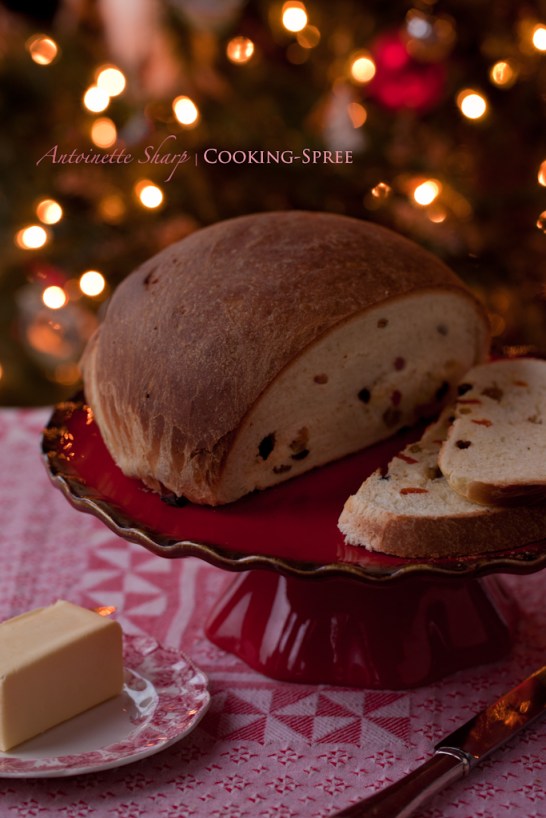
This bread is so deliciously fragrant! It’s a soft loaf, delicately but surely flavored with anise, slightly sweet and full of colorful dried fruit. It’s the traditional loaf on Italian tables for Christmas and New Years and has been a tradition in our non-Italian family since I was a kid and our mom first learned to bake homemade bread.  You can eat it with just a creamy smear of sweet butter or – as we do – toasted, with its fragrance roused to life again. We’ll have it for breakfast along with our scrambled eggs and fresh-squeezed juice.

I’ve suggested certain fruits to go inside, but really the choice is entirely yours. Mom used to make it with those candied fruits and peels (which, as a kid, I detested and had to go to a lot of trouble to pick out so I could get to the truly good stuff.) I’m saving you the trouble. Use whatever dried fruits you like…cherries, apricots, golden or dark raisins, cranberries or candied citrus rinds or softer nuts like walnuts or pecans. Traditionally, it’s one half raisins and one half other mixed fruits, but you can do all raisins if you like, or none at all. Be sure though not to skimp on the anise (neither the extract nor the seeds) because that’s where all the heady perfume comes from! Can you stand being adored? Then you will be so glad you made this bread!

Panettone – Christmas Bread

  • 2 Tablespoons yeast (or two packets)
  • ¼ cup lukewarm water (100-110°F)
  • 3/4 cup boiling water
  • ½ cup unsalted butter
  • ½ cup sugar
  • 2 teaspoons salt
  • 4 large eggs
  • ¾ teaspoon anise extract
  • 2 teaspoons crushed anise seed
  • 6 to 6½ cups all-purpose flour or bread flour  (total weight 30 ounces – or 1 pound, 14 ounces)
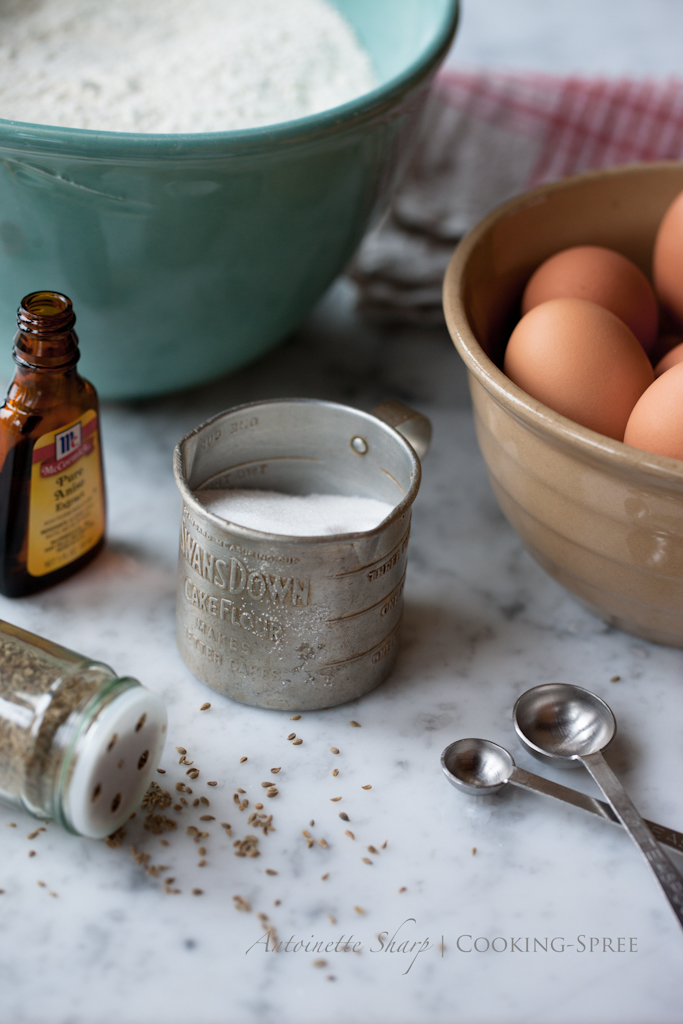
  • 2 cups dried fruit (1 cup golden or dark raisins plus 1 cup total of a variety – dried cherries, dried apricots, cranberries, dried pineapple, candied citrus rinds or soft nuts like walnuts or pecans)

My personal choice – 1 cup raisins (¾ golden, ¼ dark), and 1 cup equally divided between apricots, tart cherries and dried bing cherries. If I had on hand a bit of candied orange rind, I’d add it too, but I don’t always.

Dissolve the yeast in ¼ cup of lukewarm water. (Don’t exceed 115°F. If you don’t have a thermometer, the elbow is a good indicator of the right temp. It’s baby bathwater warm.) Set aside.

Place the butter, sugar and salt in a medium size bowl and pour boiling water over top. Stir to melt and dissolve, then set aside to cool. (Again, no warmer than luke warm.) Once it’s cooled, add the eggs, anise extract and crushed anise seeds. (You can use mortar and pestle to crush…they don’t need to be ground.) If you’ve got a stand mixer than can knead your bread for you, hooray! Transfer these wet ingredients to the bowl of your mixer.

Measure out 6 cups of flour. Have another ½ cup standing by in case you need it. Gradually add the flour to the liquid and knead with dough hook attachment for about 7 or 8 minutes (or longer if required to achieve proper consistency.) You’re looking for most of the dough to be pulled away from the sides of the bowl. When you press the dough with a finger, the dough bounces back at you. And when you lightly squeeze it between your fingers, it almost wants to stick but you’re able to ply your fingers from it without taking dough with. The surface is smooth and baby’s bottom soft.

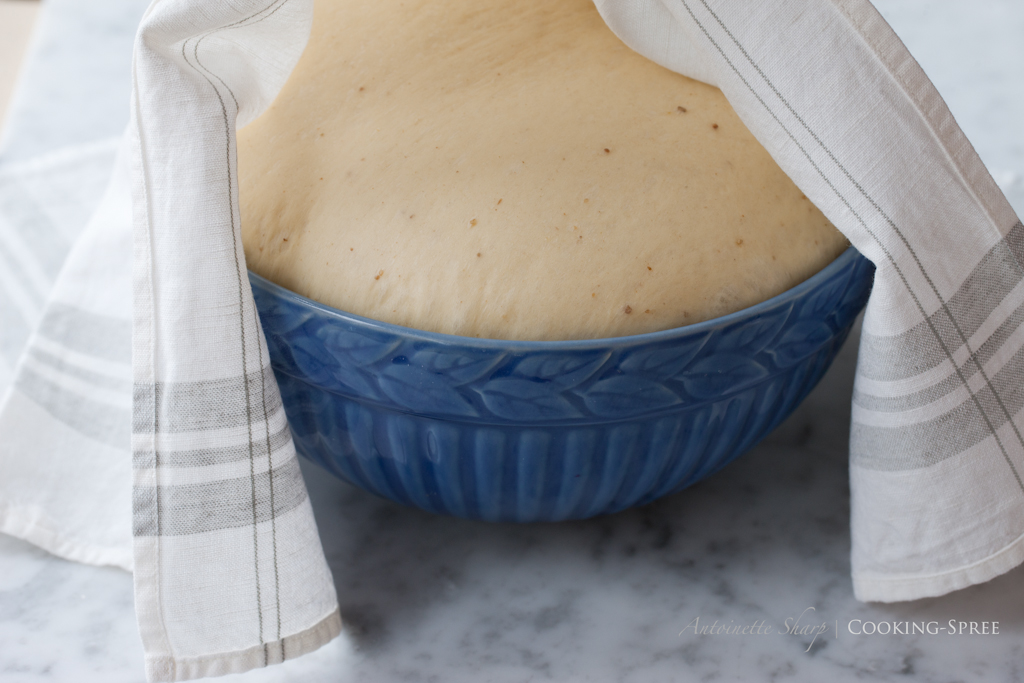
Lightly butter the inside of a large bowl. Form the dough into a ball, place inside the bowl, and roll around the sides of the bowl to very lightly coat with butter. Cover with plastic wrap. Place in a warm, draft-free place to rise for 1 hour. (My preferred place is inside a cold oven. I place another bowl inside the oven filled with hot water. It creates just the right environment, rising the dough but not too quickly. It should be doubled in about 1 hour.)

 While the dough is rising, place the raisins in a bowl and cover with boiling water. Allow to sit for 30 minutes and plump up a bit. Drain them in a collander and then place them on a clean towel, patting to dry.

Cut the fruits into approximately raisin-size pieces.  Mix all the fruits together.

Once dough has doubled, remove the plastic wrap, and with your fist, deflate the mound. One gentle punch or two will do.

Lay the dough out fairly flat; pile the fruits on top. Roll the dough around the fruit and gently knead, incorporating the fruit. Gather into a rough ball, then tuck the sides of the dough under until you’ve again achieved a smooth, round ball. Place it back inside the bowl to rise as before, a second time. Allow to rise until double, about an hour or so. (This may take a bit longer with the heavy fruit now inside.)

Once doubled the 2nd time, split dough in two fairly equal pieces. Allow to rest for 5 minutes under a towel. 

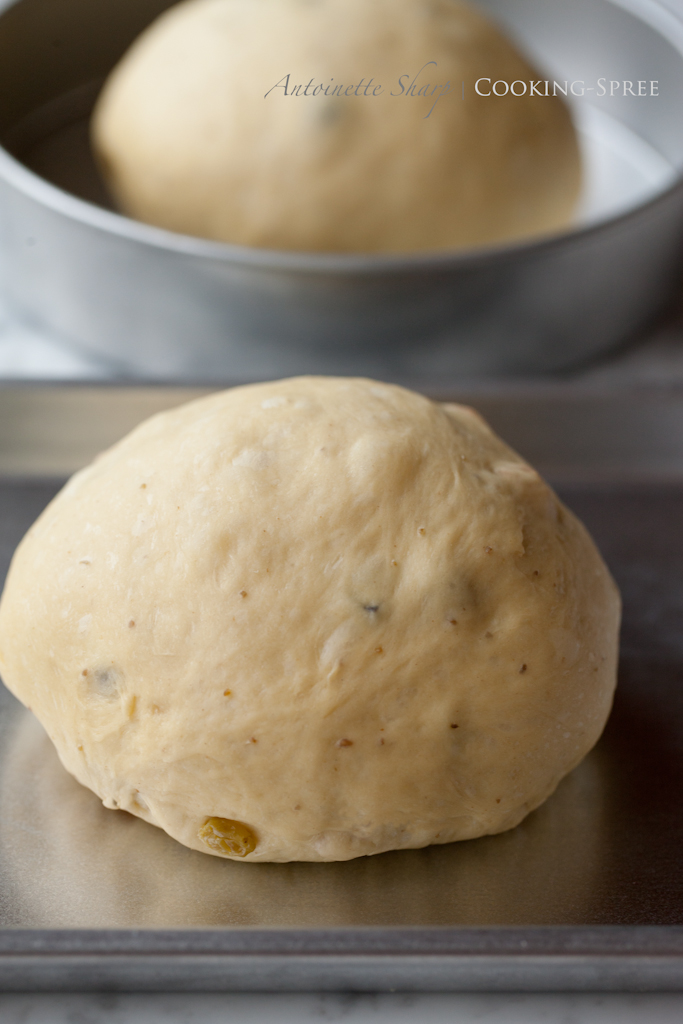
Forming the Loaves:  The object is to stretch the top, tucking the sides down and to the bottom of the loaf. Do this with the dough held in both hands, thumbs more or less on top, your other fingers continually curving over the sides, tucking the sides down and under. If that’s something you don’t feel confident about, not to worry. However you make a round loaf will be good. Put each loaf onto its own baking sheet or into individual cake pans. (You’ll want to put them side by side in the oven. If you put them both on the same baking sheet, they could rise to meet each other and meld their sides together. That wouldn’t be a catastrophe but you’ll be happier if they don’t.)
15 minutes before you expect the loaves to be ready for baking, place a rack 1/3 up from the bottom of the oven and preheat to 350°F. Brush the loaves gently with melted butter using a pastry brush.

Bake for approximately 45 minutes. If they begin to brown too much, lay a large paper grocery bag over the top toward the end. (Don’t worry, it won’t catch fire.) Or use aluminum foil if you’re leery.

Remove loaves from oven; cool completely on a rack before cutting. This bread keeps well for days, if wrapped tightly. Or bake ahead and freeze (double-bagged) for weeks or longer. Be sure to bring out before the holiday!
~ ~ ~

Tomorrow, continuing to be inspired by our travels to the southwest,

I’ll share yet another recipe with corn as the centerpiece

and some more photos from our trip.